
Vinyl Woes – bad overpriced reissues
I don’t have a huge vinyl collection – about 1000 LPs purchased over 35 years, half of which I bought since 2009. So it was time, using music collector and discogs to catalog it. The major reason for creating a catalog of records is to avoid duplicates, which appears to be a bigger problem for me with vinyl records than CDs (don’t know why). Also, there are many, many different versions of records out there, and some are better than others. Music collector is a great way of creating a versatile database of your collection, which can be then exported to your iPhone or android device. It has 3 problems: you cannot have tabbed libraries – I need to have separate libraries for vinyl, cds, cassettes and 24 bit files. But I can only have one on my phone, so I have had to use the export solution to create excel files of each of my collections. Discogs, is, obviously, awesome – although an iOS app would be the bomb if it existed. You cannot catalog your collection without it. One would think that collectorz and discogs would be fully compatible. But they are not. In collectorz you have to search for an album by artist and title, and then clumsily work your way through the 20 or so versions that it finds to find the correct one. I usually don’t bother, I find the correct titles and album art and then edit the information from discogs. It would be SO much easier if you could search by (OBVIOUS) catalog number (as you can in discos – and then it is a piece of cake). I think that the collectoz subscription thing is a bit much, as most products offer you lifetime upgrades for a premium up front (the exception is the annoying but excellent J River Media Centre).
What has been illuminating about the catalog process is just how variable my vinyl collection is. The majority of the old and second hand stuff were original or early re-press UK releases of relatively popular albums. I also have lots and lots of new release records, as I don’t really see the point of buying CDs if you can get the (more valuable) vinyl for a couple of euro more (and they often throw the CD in for free) and I have piles and piles of vinyl re-issues. The quality of these is, to say the least, Variable.
I have bought a good few duds over the past few years, mostly jazz. The con works like this: you go into a record shop (principally for me Tower records in Dublin) with a list of albums that you want to buy: for example Ahmad Jamal at the Pershing Lounge. You find a copy of the album at a reasonable price (19.99) and a big sticker boasting 180g premium vinyl, direct metal mastering 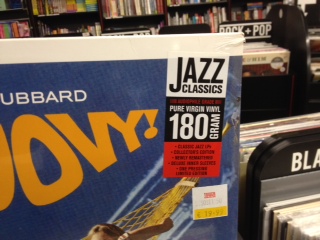 etc. and the original artwork. Most newbies would be easily deceived into believing that this was an official reissue by the original record company derived from the original master tapes. This could not be further from the truth: the majority of these reissues on Jazz trax or Jazzwax etc. are copyright expired recordings presumably from CD sources. Anything released prior to 1963 in Europe is off copyright and can be re-issued by anyone (including me): however, these record labels don’t and won’t have access to the original masters, or even high resolution digital files (unless downloaded from HDtracks or equivalent. Anyway, many, although not all, sound poor. Given that they cost 4 times more than the CD that they are derived from, can anyone spell “sucker”. One of the reasons that I stopped buying vinyl in the 1990s was poor pressings and dire sounding compilation albums.
Of course, not all reissues are bad – the majority indeed sound good, and they do of course provide you with a big lump of plastic and appealing album art. Its just that – I seem to have a number of warped and off center records, which seems to be a little at odds with the idea of premium products. It appears that the music industry and record shops have discovered that there is significant profit to be made from vinyl, but don’t pay much attention to quality assurance. Having spent a bit of time of Steve Hoffman’s music forum and other sites, I am now prepared to provide you (and me) with a list of good and bad re-issue labels. Hope it helps.
Vinyl Reissues Labels to AVOID:
- Jazz Wax Records
- Jazz Tracks Records
- Jazz Beat
- 52nd Street Records
- Doxy Music
- Vinyl Lovers
- ZYX
Vinyl Reissue Labels that I’m not sure about
- 4 men with beards
- Abraxis
- Simply vinyl
Vinyl Reissue labels that I trust but are high res digital sourced (but from original masters at least)
- Music on Vinyl
- Back to Black
- Back on Black (there may be a few titles from CD sources)
Vinyl Reissue Labels that are trustworthy (but may be high res-digital sourced unless otherwise stated)
Vinyl Reissue Labels that are trustworthy (but likely not sourced from original analogue masters – all analogue nonetheless)
Vinyl Reissue Labels to TRUST (original analogue masters and analogue processes)
- Analogue productions
- Mobile Fidelity (original master recordings)
- Music Matters (Jazz)
- Speakers Corner
- Reference Recordings (Classical & Jazz)
- Pure Pleasure (oldies)
- IMPEX
- ORG
- Mosaic
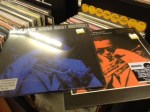
Here is an example of 2 versions of the same LP: on the left is a (excuse the glare) copyright free version of “Round about Midnight” which is probably CD sourced and retails for €22.99. On the right is a music on vinyl audiophile mono reissue that retails for €24.99 with the original artwork – and an original analogue source. For £30 on Amazon UK you can get the really high quality Mobile Fidelity version. Realistically, the copyright free version is worth around the price of a CD (€9.99 or less). How much is the MOV version worth, considering that is is likely digitally sourced from the mono CD boxset (likely 24/192 off the original master tapes)? Who knows. Stunning quality for €20 – €26 and numbered – so likely to have long term value.
 audioexchange
The info below might be dated since you wrote the above almost one year ago, but I’ll pass it along anyway. Cratedigger (iOS for sure, and their might be a version for Android or a desktop OS) is a nice enough app that uses the Discogs login and pulls one’s entire collection down so that there is a “pseudo-live” view. I only use this programme to view Discogs and compare with my Music Collector and CDpedia databases (CDpedia is one of a handful of media databases by Bruji – http://www.bruji.com/) so I don’t know much about the scanning of a CD or LP and whether that will upload to the site, but as a portable, fully searchable database, Cratedigger does well. It eliminates my need to browse the site directly in mobile view and/or read some flat file I’ve had to export and copy to my phone.
My workflow is similar to your own (as outlined above) requiring multiple databases to archive and record my music collection. CDs are easy. So are digital files from HDTtracks and the like, but Vinyl? Anything released pre-1995 can be a nightmare to get accurate information using Music Collector or CDpedia. Hitting Discogs or Musicbrainz directly allows me to verify the barcode and then select the exact match. If I have come upon an album not yet recorded, I’ll upload the info under the master record for the album in question, giving a little back to the community that has collaborated to provide such a wealth of information.
For years I had wanted some file with me that detailed what I had and what I wanted. This meant scrap pieces of paper, to small “black books” and eventually a flat text or csv file. Searching out multiple releases of the same album but with different mixes/masterings/tracks (if international) had me coming home with duplicates and triplicates, or worse! I assumed I had a release, passed on it and when I returned to the store, the item had sold.
I long for the day Music Collector and/or CDpedia will be able to interact directly with Discogs bidirectionally. Until then, scanning with the builtin barcode scanner and having the immediate ability to search numerous sources is a facility I very much cherish. Music Collector does one better and uploads the newly scanned record to the company’s web portal (if one has paid for the service). When I return home, I don’t need to have my phone connected to my computer, I just open up the programme on my desktop and synchronize with the service. The synchronization is unidirectional to minimize errors, but the ability to upload and download exists. So at worst one must repeat the speedy process to ensure all data has been replicated accurately. CDpedia works similarly, but does not yet offer a “cloud” sync. One must be on the same wifi network to sync the mobile and desktop datasets.
Once properly stored in all my datasets, I then go about the task of updating information manually to suit my needs. For downloaded files, I always modify the metadata and my preferred tools are (in this order): Jaikoz, Song Kong, Yate.
Yate is an application by some of the Musicbrainz folks that interacts via the site’s API. Its interface isn’t sexy and navigating can take a bit of time to acclimate and get the hang of it but it saves one an enormous amount of time while adding information almost impossible to do on one’s own (acoustic fingerprints for instance).
Jaikoz and Song Kong are by the same developer (a wonderful gent who is VERY prompt answering even the most trivial question) and he contributes a portion of each sale of his apps to Musicbrainz since he pulls from their system. He has also helped with some API bits too. Each of these apps replace Yate and offer interfaces that are easier to use. Song Kong is dirt simple and is meant for anyone wanting a quick but accurate tagging system. Select the folder and press a button and away it goes. A log file is printed back to the user with all changes made to the files. Jaikoz is for the meticulous folks (I’m OCD!) and for those who want to manipulate the files at the most granular level. It has automatic tagging too, but the interface might scare off those folks who aren’t interested in mucking about the metadata on their own. Personally, with thousands of LPs and even more CDs, many of which are classical recordings, an accurate tagging suit is a must.
To many, all of the above might seem way crazy even for someone with OCD, but when one has carefully built a music collection over decades, there can be a passion that isn’t readily understood by those on the outside. Even for someone with a significantly smaller collection or possessing a nonchalant sentiment about the whole thing, proper archiving is essential for insurance claims in the event of some disaster. I have a separate rider for my collection, but even those that have general home insurance, a complete list that can be handed to an assessment agent may be the difference between a few bucks laid out as a courtesy and the entire collection being recouped if/when possible.
Thanks – I have been using milkcrate for a while and it has saved me from buying numerous duplicates. Crate digger is great also.
As soon as you said “Steve Hoffman,” I quit reading. The people on his forums are complete wankers.
I don’t disagree – but there are very few places to go on the Internet to find reasonable opinions of vinyl releases.
Back on Black aka Plastichead are using CD for MOST of their terrible reissues.
There is an increasing number of poorly mastered dubiously sourced records on sale at unpalatable prices. I have gotten to the point that I am not buying new reissues unless there clear audiophile lineage. Last years’ ELO reissues really bothered me (they didn’t even sound as good as the CD). Strangely, however, my most disappointing recent purchase was an Analogue Productions 45rpm remaster of “Idle Moments” by Grant Green. Despite the Grey/Hoffman sticker the record was completely blown away by the high res digital version on Qobuz.
Thanks for the great info. Do you know of any “trustworthy” Canadian vinyl suppliers?