
Music Matters SRX vinyl: the verdict is in!
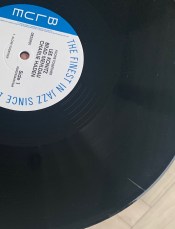 There was a lot of action in the Blue Note vinyl world this year – the much touted Tone Poet series – which was excellent despite the releases emanating from the “lesser” part of the catalog. The Blue Note 80 vinyl series has also sold well – although I have my own misgivings about the quality of the product. I have now returned my fifth record due to quality control issues: in this case as soon as I opened the long awaited Lee Konitz release – I noticed a long gash on the record crossing the first track (see picture on left) and yep – I was audible. I know that Optimal has a great reputation as a record pressing plant – but I have grave doubts (see below).
In any case, after waiting a year – I obtained the holy grail of Blue Note reissues, the one less talked about – the Music Matters SRX vinyl set. This came out in January and featured 12 33rpm Blue Notes pressed onto a new vinyl product – SRX. Here is the blurb from their website:
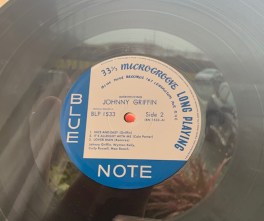 “SRX stands for “Silent Running Xperience.” SRX is our own formula, conceived and developed by Rick Hashimoto of Record Technology and manufactured by NEOTECH. Its noise floor is fathoms lower than any other vinyl we know of out there past or present. Records pressed with it look like normal black discs until you hold them up to the light and see that they are translucent and smoky, silvery gray in color.” [see image to the right – it is indeed silvery gray transluncent plastic]
“The near-perfect silence of SRX Vinyl virtually frees the music from groove noise and draws you further into the listening space, setting it in relieve so distinct, full and spacious it’s nearly sculptural. You hear more of what’s on the original tapes, not only of the notes played on the instruments but the experience of the event itself. That’s why we call it Silent Running Xperience.”
Big talk – indeed – this is almost certainly the same product – a carbon free translucent vinyl record – that Mobile Fidelity are promoting for their Ultradisc Releases. When MOFI switched to the new formula for new one step releases, they increased the price by 25% (remember this is 2x45rpm). The SRX series is 1x33rpm, standard pressing system, and retails at about $60 (50% more than the original price of the 33rpms, and about the same price as the 45rpm releases). Aside from the vinyl, the product is indistinguishable from the MM 33rpm series, gorgeously presented and packaged – now familiar to those who have bought the Tone Poet series.
And so to the music: the first record I spun was Sonny Rollins (vol 1.). This record sounded reasonably good – but the centering of the musicians was a little odd – panned slightly to the left – on a mono recording – where Rollins and Donald Byrd should not be. I listened to the excellent 24/192 file(s) that I bought from Qobuz a few years ago and the musicians were dead center – and, honestly, I think the digital version sounded better. Horace Silvers’ “Song For My Father” is instantaneously familiar to Blue Note (and Steely Dan – “Ricki Don’t Lose that Number”) fans. I have listened to the album hundreds of times in all kinds of formats. After a quick skip, a lot of pops and crackles – leading to a good deep cleaning – the album opened up to me, and yes – that slick buttery appearance of the vinyl emerged. It is certainly the best version that I have heard to date.
I also listened to “A Night at Tunisia” by Art Blakey, “Afrocubism” by Kenny Dorham and “Blues Walk” by Lou Donaldson. The latter, I have been listening to a lot at 24/192 recently, and the vinyl record was more engaging, more spacious with better dynamics. The Blakey and Dorham records were staggeringly good.
The two records that were of most interest to me, were “A Blowing Session” and “Introducing…” both by Johnny Griffin. Why? Because I have a 2x45rpm version of the former (Music Matters 2011) and a BN 80 version of the latter (mastered by Kevin Gray at Cohearant) – so any potential difference in sound between the records would be due to the quality of the pressing and the vinyl.
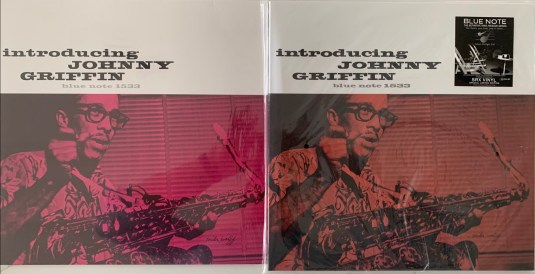
Introducing Johnny Griffin: the first thing that you notice when you put the two albums side-by-side is the remarkable difference in the appearance of the cover (the BN 80 cover is on the left above). The Music Matters cover, featuring a picture of the great sax man, has a bluish red background (thanks to Discogs and a 2009 reissue from Analogue Productions – this is the correct color), the BN 80 cover is a kind of fluorescent pink. Likewise, the back cover of the MM-SRX is an excellent reproduction of the original – the BN 80 is ok – the font isn’t the same and it looks a little bit amateur (thankfully without the sentence repetition and syntax errors of earlier releases – does anybody proof read the liner notes?). Inside the MM-SRX is packaged in a plastic inner sleeve – reasonably good, the BN 80 is in sandpaper (honestly – Waxtime, Jazz Train and all of those copyright free companies at least press the vinyl flat, without scratches, well centered and with plastic lined paper inner sleeves).
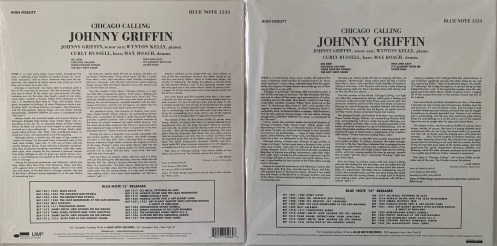
BN 80 left, MM-SRX right
Taking the records out – the BN 80 has a sharpish edge and needs a bit of a push to get it loaded on the turntable (the center hole isn’t punched through very well), the SRX has a smooth outer edge and looks distinctly different. The matrix numbers are different – so it is likely that Kevin Gray cut different lacquers for the two releases.
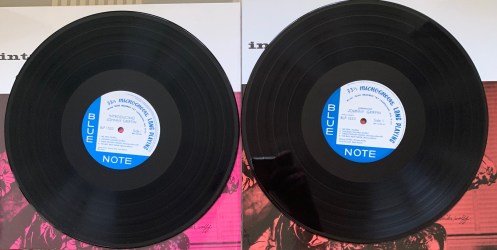
BN 80 left, MM-SRX right
So, more importantly, onto playing. First up was the BN 80: the record sounds a little thin, with narrow soundstaging, ok dynamics – almost CD sounding. I didn’t feel at all involved, and noted that I had only listened to the album once before, the day it arrived. In comparison, the MM-SRX immediately reminded me of previous MM records: huge soundstage great three dimensionality – fabulous reproduction of the horns, in particular. It was thoroughly involving – so much so that I didn’t want to get out of my seat to test side 2 of the BN 80 version, which was again comparatively disappointing. Winner by a mile, MM SRX.
The other comparison that I did was Johnny Griffin’s “Blowing Sesssion.” What a lineup – Griffin, Morgan, Mobley Coltrane, Wynton Kelly, Blakey and Chambers – Los Galacticos of the time! I have both the 2011 2x45rpm and the new SRX version. Interestingly, the 2×45 is significantly less expensive on the Music Matters website ($45) than the 33prm SRX version ($60). The record covers and liners are the same. Both records sound great – but the SRX version has better mid-range reproduction and bass depth (and boy the bass goes deep – remarkably so, given that this is a 33rpm album). The sonic differences are particularly notable on “All the Things You Are.” There is one proviso here – I believe that the 2×45 was mastered at Acoustech (Gray and Hoffman) – and, generally, I don’t think that these records sound as good as later Cohearant releases.
Overall, it is a win for Music Matters SRX – they are likely the best sounding versions of popular Blue Note recordings from the 1950s that you will be able to afford. Are they worth $60? I don’t know. Probably,
It seems to me that the Blue Note 80s are looking more and more to be a false economy – principally down to the pressing plant, I would assume. I had hoped that any Kevin Gray product would be great, from my own experiences with Analogue Productions and Music Matters – but pressing definitely matters more than you would think. Of course there may be better sounding versions of the BN 80 Johnny Griffin out there (as I learned from the Herbie Hancock release)……
 audioexchange
Thanks for the comparison. Very interesting. Are they worth 60$? Now I do not know where you got them from, but to import one from the MMJ website which is, AFAIK, the only way to buy these products new would fetch 95$ after shipping plus taxes for a total of 120-125$.Sure, buying a few at once might save up something, though unluckily taxes are still around 20% of the final total including shipping. The least it would cost is around 95€ after a ballpark calculation. Blue Train was on ebay last week and reached something in the region of 95GBP, if my memory serves me well, but did not meet the reserve price. . I will definitely never buy these if MMJ do not change their price and distribution policies. Still hoping BN will buy off them some stampers..
The best option is to have them delivered to a friend or family member in the USA and have them carry the records back with their luggage. You are allowed, as far as I know, €300 value per person at customs versus the ludicrously low €20-something by mail (including postage). You can get Amazon to deliver to a delivery box near your hotel, if in the States on holidays, unfortunately they don’t carry a lot of audiophile vinyl. Neither Music Direct nor MM seem to provide that service. The records may be worth $60 plus tax (usually 7%), but not €95+.
Unfortunately the vinyl gourmet does not carry these titles as they are only sold direct by Music Matters.
All of these SRX recordings are now either sold out, or fetching stupid prices on Discogs. The tech sounds great, but it was a mistake if people just take advantage of others for money because of it. I’ll likely never hear one of these in my lifetime, unless I want to drop a ridiculous amount for one record.