
A Short Note on West Coast Jazz….
[I started writing this last summer and never posted it ]
In the years to come everyone will ask you – “what did you do during lockdown?” and I’m sure everyone will talk about how they beat boredom, learned to cook properly, watched countless murders and assaults on Netflix, took up sea swimming, drank themselves senseless, wrote their first novel etc. I worked. But, to keep myself sane – I immersed myself obsessively in the world of American Jazz from 1954 to 1964, principally, but not exclusively, that much forgotten – and often derided – variant “West Coast Jazz.”
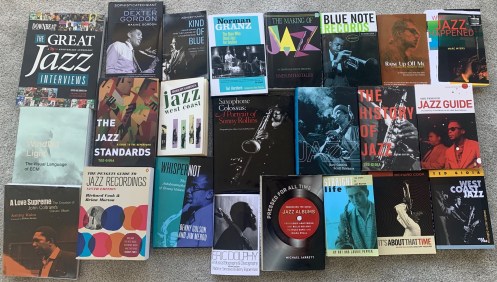
To most fans jazz is about New Orleans in the 1920s and New York from the 1940s onwards. In between was god-awful “swing” that was really pop music played with a little bit of syncopation. Modern jazz started with Charlie Parker and the stuff played on the West Coast was by white guys who sold out and went into the studios. Oh and jazz is an American art-form and Europeans are just copycats. WRONG WRONG WRONG WRONG.
Following World War II the swing bands and orchestras limped along and finally disbanded, due to the falloff in popularity and loss of revenue. Many musicians took advantage of the GI bill and went to college, studying music and had a desire to become both musically adventurous and to compose and orchestrate. Some relocated to Los Angeles and San Francisco, to take advantage of the burgeoning club scene (Central Avenue in LA) and agreeable climate. Simultaneously, following late night jam sessions in Mintons and other clubs, a group of artists (Gillespie, Parker, Kenny Clarke, Bud Powell etc.) who felt less constrained by harmonic structure developed “bebop” – characterized by rapid fire solos of almost impossible verve. Slightly later, a more orchestrated or laid back version of modern jazz was developed in New York – by Gil Evans, Gerry Mulligan, Miles Davis, Lennie Tristano, Lee Konitz and others that acquired the label “cool jazz.” This tarnished moniker subsequently became associated with the more melodic music of the West coast that combined the urgency of bebop, the counterpoint of dixieland, the complex arrangements of swing, and the airiness of chamber jazz. In many ways, West Coast Jazz (WCJ) was the fore-runner of ECM, ACT, Steeplechase, Black Saint and other European labels. Moreover, WCJ evolved into Post Bop, Hard Bop and Avant guard – but not Soul Jazz or Funk, mostly because jazz on the coast was all but dead by 1964: its major musicians had emigrated to New York or Europe, were locked up in jail or dead, worked in the Hollywood studios or abandoned Jazz altogether.
Musicians from the West Coast who made their names elsewhere:
- Dave Brubeck
- Eric Dolphy
- Dexter Gordon
- Charles Mingus
- Chet Baker
- Art Farmer
- Paul Desmond
Musicians from the West Coast who stayed by still became legends
- Art Pepper
- Hampton Hawes
- Chico Hamilton
- Andre Previn
Musicians from the West Coast who should have become legends
- Sonny Criss
- Buddy Collette
- Teddy Edwards
- Harold Land
- Wardell Gray
Musicians who settled on the West Coast and recorded there (at least for a while)
- Jimmy Giuffre
- Clifford Brown
- Shelly Manne
- Gerry Mulligan
- John Lewis
- Barney Kessel
- Sonny Clarke
- Jim Hall
- Bud Shank
- Bill Perkins
- Conte Condoli
- Curtis Counce
- Lawrence Marable
- Frank Rosolino
- Herb Geller
- Jack Sheldon
- Herb Geller
- Benny Golson
- Stan Getz
- Jack Montrose
- Bob Gordon
- Howard McGee
- Benny Golson
- Bill Holman
- Phineas Newborn jr
- Red Mitchell
- Cy Touff
Legendary West Coast Sidemen (who also made leader records)
- Leroy Vinneger
- Stan Levy
- Russ Freeman
- Red Mitchell
- Carl Perkins
- Richie Kamuca
- Chuck Flores
- Frank Butler
- Bob Cooper
- Frank Morgan
- Claud Williamson
- Bill Watrous
- Jimmy Knepper
At some stage I will post a list of “must have” WCJ recordings.
 audioexchange