
Kind of Blue Super-test
Early in the summer I managed to obtain the new Analogue Productions clarity vinyl super audiophile (super expensive) version of “Kind of Blue (Miles Davis 1959).” I have many digital and analogue versions and I thought it would be worthwhile to do a group comparison test to see if this version is really as good as billed. My colleague, Leo, agreed to do an independent assessment, which was helpful as he had a copy of the 2015 Mobile Fidelity (MoFi) release.

Pretty much anyone with a record collection has a copy (or three) of this seminal album – and I have never heard a bad version of “Kind of Blue (KOB),” either digital or analogue. So the bar is set fairly high.
First, some background on the actual source tapes for KOB.
We know that during the original recording the engineers ran 3 track tape recorders – a primary one and a safety, that recorded two reels – one for each session, and that these were used to produce the original stereo masters. There may have been another set of tape recorders to produce the “mono” mix. The mono release would have been the principle version of the recording that was sent out to record shops in 1959-60; the stereo version (really 3 mono tracks folded down to “stereo”) would have received minimal attention. As stereo became the de-facto standard in the mid 1960s, the mono tapes were forgotten or jettisoned – and have not been seen for, perhaps, fifty years. KOB has been re-issued hundreds of times, and, until 1992, the principle source was the original stereo (3:2) master tape that was spliced together from the master reels, stuck together with scotch tape. We know that the primary 3 track recorder ran slowly – so there was a speed issue in all stereo versions of KOB until Mark Wilder discovered the anomaly in 1992. Nobody seems to have noticed, including Miles Davis, that the primary master reel was off pitch for 33 years.
When Mark Wilder and colleagues went to the Columbia vault in 1992 (as part of a Miles Davis reissue project) they found 5 tapes: the original session tapes (two of them), the mix-down stereo master (in poor condition) and the two safety tapes of the original sessions (3 track). No mono master tape. The safety tapes had been untouched from 1959 until 1992. Wilder used the safety to create the “speed corrected” 20 bit mastered gold CD released in 1994.
All pre 1990s versions (vinyl, cassette, 8 track, reel-to-reel, CD, including the originals – although, presumably, not the mono originals if, indeed they used 4 tape recorders) were mixed down from the original 3 track tapes (2 different reels) to mono and stereo masters. All of those primary tapes (3 of the 5) either no longer exist or are too badly damaged to use. That leaves us with the “safety” clones of the master reels.
Wilder and Steve Berkowitz remixed and remastered the 3 track safety tape in 1997 to produce the modern two track MASTER. This master is on TAPE (it is analogue and you can read about it here). The new master was used in 1997 for that CD edition. This was used again with a different playback deck for the 2008 “remaster” (the 40th anniversary edition) – for both vinyl (Greg Calbi) and digital releases. It is also the source of the SACD releases. If you read this article, it would appear that Berkowitz (producer) and Wilder (engineer) went back to the 3-track reels in 2013 and digitalized them at 24/192 before folding them back in to a mono or stereo mix. The safety reels were also used to produce the mono vinyl version (AAA) in 2013.
In summary – all Columbia records releases of KOB during the past 30 derive from work done by Mark Wilder on the safety reels.
In 1994 Bernie Grundman did a “live” mixdown of (I believe) the original 3 track tapes to create lacquers for the Classic Records (CR) version (released in 1995). Grundman did not use the 1997 “new” master tape. The original stereo master by then had been “retired” – hence the Wilder version. Grundman used the Wilder CD to correct the pitch on the first side (this was not needed for the 1997 master as the safety was used) and compared the sound to a mint first pressing of the album. If Grundman had to correct the pitch, he must have been working from the original reels (not the safety). It was a flat transfer with no EQ. The lacquers generated a mother from which stampers were made.
The album was released at 33rpm in 1995 and subsequently at 45rpm in 1999.
As Analogue Productions (AP) now own Classic Records, they possess the metal work (the mother) from the Grundman master. This is as good as having the original master tape – and straight clones of the Classic records (CR) releases can be released ad infinitum (until the mother wears out). The CR/AP (!) version is one generation earlier in the chain than the Wilder analogue master (but at the same level as the digital remaster). Hence, this version should be truer to the original master tape because it is derived directly from the multitrack masters (i.e. there was no stereo master tape involved). The CR version was a double album that included speed corrected and speed not corrected side 1. The current AP version is 33rpm, pitch corrected. I am certain that AP will release a 45rpm version when they have sold all 25,000 33rpm copies.
Here are the versions involved in the evaluations, below.
Version: Analogue Productions 2021
Source: 3-track original multitrack (3 track) masters
Mastered by: Bernie Grundman (1995 for Classic Records, original metal parts). Classic records was sold many years ago to Acoustic Sounds (Analogue Productions).
Format: Stoughton Tip-On jacket, 1 x 33rpm Clarity Vinyl. Flat profile (normal records are bi-concave– the needle goes downhill for the first half and uphill for the remainder).
AAA
Version: Mobile Fidelity 2015
Source: Original master tapes (1997 Wilder remaster) – this came from the Wilder sessions for the 40th anniversary edition.
Mastered by: MFSL
Battery Studios’ Mark Wilder’s 1997 three-to-two-track mix down to analog tape produced playing back the three track tape on a pristine all tube Presto deck and using a GML custom line mixer and producing a flat transfer at 15IPS using Dolby SR onto an Ampex ATR 102.
Greg Calbi used that mix to produce the lacquers for the 50th Anniversary blue vinyl version and that is what Mobile Fidelity used here.
Presumably MOFI engineers were given access to the New Master Tape (NMT) and made their DXD copy, that was subsequently cut to vinyl
Deluxe packaging, 2 x 45rpm
Cut from DSD 256 files (updated September 2022)
Version: Music On Vinyl 2013 Mono (numbered record store day version)
Source: “Original master tapes” (Wilder 2-track master)
Mastered by:
ADA (likely – the US Columbia version was AAA – but I suspect that this is a 24/96 digital file sourced version)
The US version was re-mastered at Sterling Sound and pressed at RTI (click here for version)
Numbered limited edition with poly lined inner sleeve and correct cover (wider angle) for the mono version.
(I eventually obtained a copy of the US Legacy edition – believed to be AAA. It is sonically better than the MOV version, but not sufficient to change the scores below).
Version: 40th Anniversary Collection 2009
Source: “original master tapes” – Wilder from 2-track 1997 fold down master.
Mastered by Greg Calbi
Format: blue vinyl in a nicely packaged box set. Vinyl is notorious for complaints about the pressing quality.
AAA from the 1997 remix remaster: this version was subsequently used in the MOFI reissue.
A digitalized version of this release came out on MOV as a 2LP set in 2010 was well regarded
Version: DeAgostini version 2016
Source: unknown
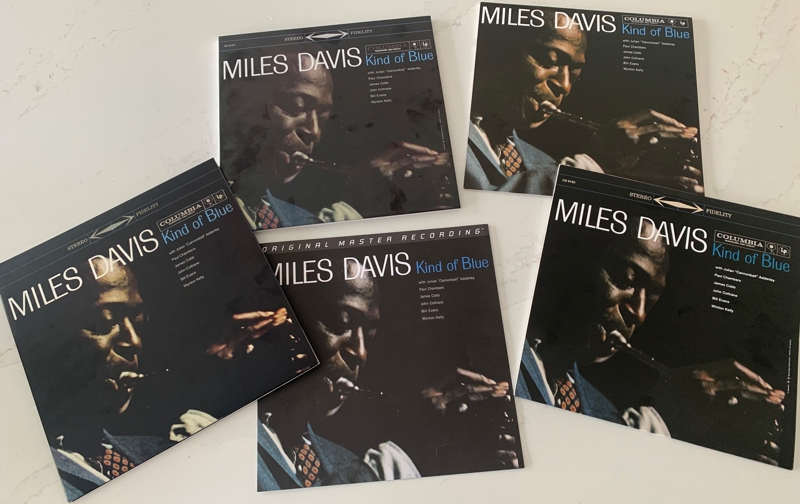
This was the first issue of the wonderful “Jazz at 33” series, released originally in Italy in 2011 and subsequently in the UK and Ireland in 2015. As far as I remember, the sticker price for the first issue was £4.99 (translating to about €10 with all of the ridiculous markups). It came with a nice, although not detailed magazine, a poly-lined sleeve and some mistakes on the cover. Wynton Kelly is credited as Winton Kelly, Adderley is correctly spelled (unlike the original). My hunch is that the DeAgostini version is the same as the 40th Anniversary version.
Listening Tests
We used Benchmark pre and power amps due to their extreme transparency.
Technics SL-1200>Ortofon 2M black>Graham Slee phono preamp>Benchmark Dac1 pre>Benchamark AHB2>Nordost Cables>Magnaplane LRS
Clearaudio Concept>CA Maestro>Clearaudio Basic V2> Benchmark DAC2 HGC>Benchmark AHB2 (or Croft 7)> Nordost Cables > B&W CM7
| Analogue Productions | MOFI 45RPM | 40th Anniversary | MOV MONO | DeAgostini | ||
| Music | 10 | 10 | 10 | 10 | 10 | |
| Cover & Packaging | 9 | 8 | 8 | 7 | 7 | |
| Silence (background) | 9 | 8 | 7 | 8 | 8 | |
| Treble | 9 | 8 | 8 | 8 | 8 | |
| Mid | 8 | 8 | 7.5 | 7.5 | 7.5 | |
| Bass | 8 | 7 | 6 | 6 | 6.5 | |
| Clarity(muddiness) | 9.5 | 7.5 | 8 | 8 | 7 | |
| Soundstage | 8.5 | 9 | 8 | 6.5 | 8 | |
| Engagement | 9 | 8 | 7.5 | 7.5 | 8 | |
| Total (out of 80) | 71 | 65.5 | 62 | 61.5 | 63 |
We conducted a 2 person listening test of all 5 versions, independently. Both sides of each record. Where there was disagreement on scores – the half way point is listed above. In the totals listed above, we did not include the cover and packaging in the final calculations due to the huge price differential between the audiophile/box set and the standalone MOV and magazine copy. Unquestionably, the best cover is in the most expensive Analogue Productions version (i.e. the record cover not the annoyingly large plastic box – that basically contains a magazine quality liner book and a few useless inserts). The MoFi version came in a box highly reminiscent of Mosaic Records box sets, and was rather attractive. The 40th anniversary had 2 CDs and a DVD tucked inside the gatefold and an excellent hard backed book – one of the rare ones that come with deluxe editions that I have read “cover to cover.”
Result
The new/old Classic Records/Analogue Productions version was a clear winner,* but both of us noted that we could live with any of these versions (although the mono was the least liked). We both considered the DeAgostini (£4.99 in the magazine) version to be audiophile sounding, and very similar to the 40th Anniversary, but pressed on better vinyl: absolute bargain if you can find it. The US mono version is a definite if you can find it (try Amazon, seriously).
Addendum: after conducting the test my friend was so disgusted with the MOFI KOB that he decided to sell it. We did a trade – an old Astell & Kern DAP for the album. I figured that it would be collectable in the future. The price has tanked since the MOFI digital on vinyl revelations. (Sept 2022).
Next time- The Blues and the Abstract Truth
*there are a couple of loud pops on the album – they may come out with a good cleaning (I will update at some stage).
 audioexchange
[…] of artisan pressing machine – the metal parts were recycled from the Classic records version (the original masters are no longer usable). Indeed, these metal parts were from the “Original Master Tapes” – unlike the […]
[…] long ago, with a friend, I did a multi disc comparison between the Acoustic Sounds (Classic Records) version of Kind of Blue and various other copies – […]