
The Return of the Music Centre
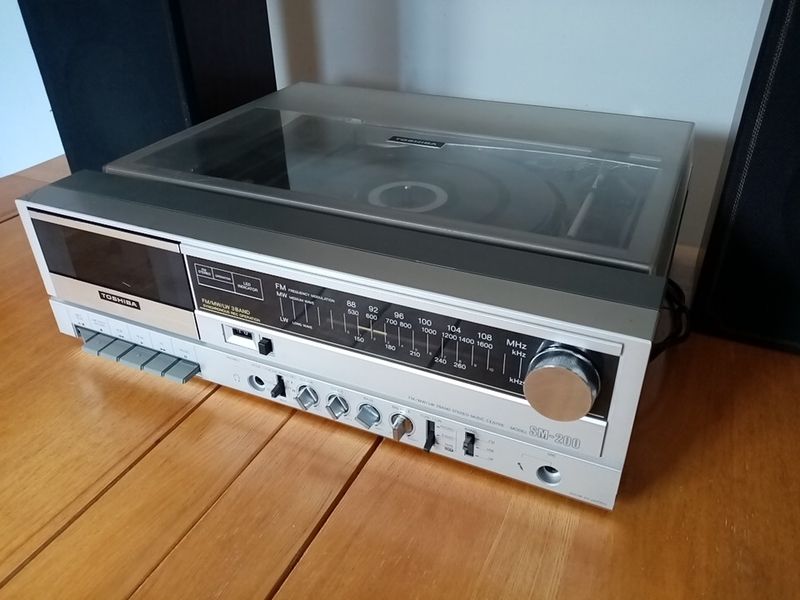
In 1984 I saved up every penny that I could beg, borrow or steal to buy a Toshiba 3-in-1 music system. This included a record player, a cassette deck and a radio. It was fantastic and one could make up mix tapes – recorded from vinyl or FM of favorite songs to play on one’s Walkman or other brand portable tape player. This was jettisoned in the early 1990s for a Pioneer “mini system” – that replaced the turntable with a CD player, and included dual cassette decks (to copy mix tapes etc.). This, in turn, was rapidly replaced with serious hi-fi: a separates system. Needless to say, once one became a “separates” person (i.e. a hifi snob) – well you can’t turn back. Anything that contained more than one component (including AV receivers) were “lifestyle” or “budget” and definitely non audiophile. Unfortunately, like anyone who ever developed an interest in hi-fi and lived in a family, separates mean wires – lots of them – and several boxes – each with power cables and wires going in an out of them. To give you an example (current system without tape deck): turntable with upgraded power supply (1 plug) with connection wires into phono pre-amp (plug), connecting to pre-amp (another plug), connecting to power amp (another plug) connecting to speakers (I currently have two power amps with a switcher box – so double the cables and the plugs here). I also have an Oppo Blu-Ray player (plug, analogue and digital wires into DAC-preamp and ethernet connector), an streaming box (plug, ethernet cable and co-axial digital cable), a sonos ZD-95 (plug, ethernet, plus toshlink out). That is a lot of plugs, cables and wires – all so that I can listen to my digital music collection and a few (thousand) records. The whole thing generates enough heat to change the local climate and probably enough electromagnetic energy to uncouple and MRI scanner.
In the TV room, I have long since given up on the possibility of wired surround sound and caved into the very “lifestyle” orientated Sonos surround system (arc soundbar, sub and play 3 surround speakers). It may not be audiophile but it is a very agreeable sounding system.
I have long pondered having a purely digital hi-fi system in another location. This would require a streaming box, a pre-amp, a power amp – 3 plugs, 2 sets of interconnects and components not talking to each other. Ideally the streaming box would take any input (ethernet, USB and USB disc), play every audio file system in existence, and have a really nice full colour tactile display. Bluetooth and Airplay are a must – you need to be able to stream Audible from your phone. The pre-amp would, of course, have to accept a MM phono input because – well you never know where you might want to listen to records, and HDMI-arc because – well you never know where you might want to place a TV. As the system would have to be located in a cabinet, the power amp should not produce sufficient heat to melt glaciers. Several manufacturers have developed integrated amps with digital inputs (saving a lot of plug and cables) but few have done so with integrated streamers and displays. Two British companies have led the vanguard to making audiophile all in ones – Naim (with the Unite Atom) and Cambridge Audio (with the Evo 75 and 150).
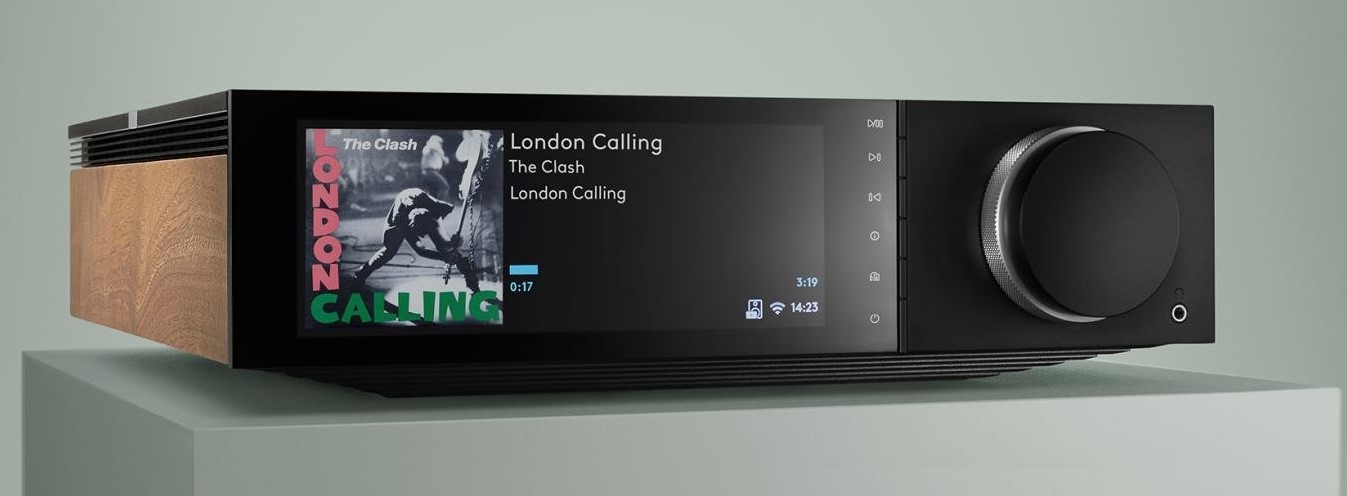
I decided to give the EVO 150 a go: it ticked all of the boxes. You can read elsewhere (there are a gizillion reviews of this product out there) about the specifications. First things first – this is relatively small (2/3 the size of a standard hifi separate) and it looks really cool (with a large non tactile – major limitation – display). There is a large dual function turn knob on the front to select myriad inputs (including MM and HDMI-arc and USB drive and USB etc) and volume. However, if you really want to control the device you need a local network (not great in the office – you might need a network extender like this one) and the nice (but not brilliant) StreamMagic app (ios and android – but doesn’t seem to be available for the Amazon Fire). Once you connect up the device by wifi or ethernet, attach speakers and point the device at your network, attached USB drive or Roon – off you go. The amplifier is class D – switching not digital (it is an analogue device – hence the MM input) – similar to the Sonos soundbars. This type of technology is considered exceptionally uncool to audiophiles who prefer heat generating tube amps – but it is the technology of the audiophile future and it is improving at an exponential rate. Cambridge Audio (Richer Sounds) are a major (budget) audiophile manufacturer with several decades of experience – in particular with digital technologies. They have never made a bad product. For the Evo, they bought in the class-D technology and applied their “UK-sound” to it such that it would sound just like their best integrated amplifiers. And boy does the Evo sound good: huge soundstage, deep bass (I used the excellent Martin Logan 35xti speakers), tremendous precision, timing, space, clarity. Wow!
The EVO effortlessly played a variety of DSD recordings from an external HDD (although the library function in this setting is clunky), PCM files at all kinds of sample rates, apple lossless, flac – you name it – with gorgeous album art displayed. Connecting to a PC – Qobuz happily streamed at 24/192 and the music sounded divine (no album art though).
I plugged a Project Debut Carbon turntable, pre-amped via a Rega Fono MM mark 3, into the “line in” socket of the Evo. It sounded horrible – having presumed that the MM input was a bit crap – it was not. Taking the Rega out of the system and plugging the Project turntable into the Evo the sound was excellent – not amazing (relatively inexpensive turntable and cartridge here) but good enough for an extended listen. I was and am impressed. In many ways the Evo represents the device that I have been looking for since I started “ripping” my CDs 25 years ago.
The Cambridge Audio Evo represents the future of hi-fi. Retailing between €2000 and €2500 in Europe it is an absolute steal when one considers the number of components and connectors that it replaces. No this is not a reference system for discerning audiophiles – but most of those would be very happy with the Evo as a second system (particularly where there is a TV – far superior to most soundbars) or in an office. Five stars.
 audioexchange