
How Much Should I Pay For A Vinyl Record?
I was asked last week by a colleague “who I was listening to.” I couldn’t resist saying “Kevin Gray (240 records), Ryan Smith (82), Chris Bellman (125), Bernie Grundman (175), Miles Showell (42), Manfred Eicher (57 and countless CDs) and Shelly Manne (90).” The first four are, of course, well known vinyl mastering engineers with tremendous reputations for the quality of their products.
As the vinyl revival has matured over the past 15 years, many of us who naively bought records in shiny new jackets with “180g audiophile” stickers have come to realize that a significant proportion of these products were of unacceptable low quality. The major complaints reflect the mixing quality (the “loudness war”), the provenance of the master (usually digital – 16/44), the mastering process (and indeed the calibre of the engineer), the pressing plant (RTI good, United bad, Pallas good, GZ and MPO not great), the quality of the vinyl (warped, off centre, infill, noise etc) and the quality of the packaging (sand paper inner sleeves, low quality poorly reproduced covers etc.). Most of the albums that are sold in your local retailer fit into this group – and for €20 or $20 – for a nice new copy of a favourite album – the majority of people are pleased. That is, until they listen to their original worn version and realise that the heirloom sounds much better. Without grumpy audiophiles the record companies would continue to dish up nothing but this kind of stuff, until the market inevitably collapses and they cook up another method of selling us albums that we already own. So what are “audiophiles” looking for…..
As a consequence of this learned knowledge – thanks to Discogs, Stereophile, Hifi news, Analog Planet, internet forums (Hoffman in particular), YouTube etc. one develops a sense of “vinyl pedigree.” It works something like this:
- Is the record new or is it a re-issue. If it is new the source is (almost) always digital. That is not necessarily bad, as new vinyl from ECM or Blue Note (amongst others) can sound amazing.
- If it is a reissue – was the original recorded before the “digital” era (i.e. from 1982 onwards)?
- If it was recorded before the digital era – were the original (or early copies) master tapes used (all analogue) or were the original multi-track masters used? There is a distinction here – using the multi-track masters allows for a modern “digital” remix that may seriously outperform the original analogue version (e.g. Steven Wilson’s work on Jethro Tull, Giles Martin’s work on “Sgt Pepper” and “Abbey Road”). In many cases the original analogue tapes are no longer available (e.g. the Universal fire in 2008) or no longer usable. In such cases there may have been a very high quality digital archive copy made – preferably in DSD (direct stream digital) – from which the vinyl remaster was cut. A good example of this is the 2010s Rolling Stones (good value) vinyl reissue series from direct stream digital (DSD not the horrible loudness war versions of “Sticky Fingers” and “Exile”).
Ideally, the source for the album was the original analogue master and these were used to directly cut the lacquers (all analogue recording mixing and mastering – AAA). Not infrequently one will encounter the sentence “sourced from the original master tapes” – which can mean anything including using a first generation CD from the master. Often these original masters are digitalised to 24/96 (rarely higher) PCM and the lacquer is cut from that file. When you see the term “half speed mastering at Abbey Road from the Original Analogue Masters” this is exactly what you are getting – a careful cut lacquer from a digital file. Another example is “A Saucerful of Secrets” by Pink Floyd. The album has just been re-released (originally an RSD reissue in 2019). The hype label states: “remastered from the original MONO MIX” and “remastered from the original MONO analogue tapes by..” What they don’t tell you is that the tapes were transferred to digital and those files were used to cut the lacquers. There is nothing necessarily wrong with this, but the music has spent time in the digital domain and is therefore not an authentic reproduction of the original analogue source tape. - Where was the record mastered? We are now in the era of the “high pedigree” mastering studios: Cohearant, Sterling Sounds, Bernie Grundman Mastering, Abbey Road etc. which indicates a reputation for high quality and knowledge that only the highest quality sources were used (and by the way – they are all willing to “cut from CD”).
- Who was the mastering engineer (see the short list above)? Within the mastering studios there are superstars with individual reputations (e.g. Ryan Smith at Sterling Sound Nashville, Krieg Wunderlich at MOFI).
- Was the record cut at 45rpm or 33rpm? Many audiophiles prefer 45rpm – they believe that more detail is captured; but these records are a less comfortable listening experience – constant flipping (but if you want convenience – stream).
- What was the process of producing the stampers? Was this “one step” (i.e. one lacquer for each stamper) or conventional (many stampers from a single mother). The “one step” process should theoretically contain more information as there is a one generation fewer in the production process.
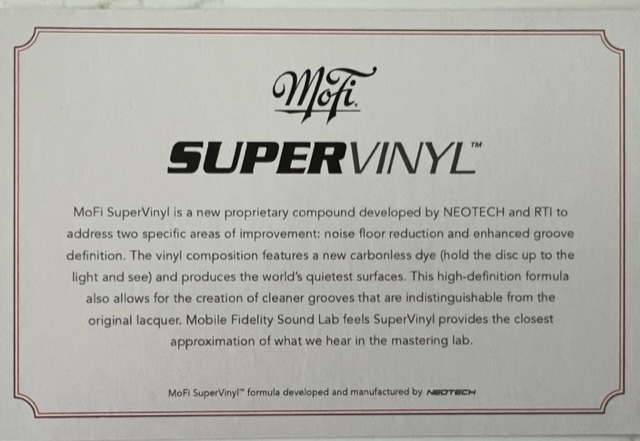
- What type of vinyl was used? Vinyl is a colourless material. Black is usually added but vinyl can come in any colour (slightly noisier) or with an impregnated picture (don’t bother – these are for display only). There all kinds of modern vinyl compounds that are thought to capture more information – sold with different names by different labels – but we will just call it “supervinyl.” Mobile Fidelity’s super audiophile product is a reissued album, (usually) cut “one step,” from the original masters (not necessarily AAA), at 45rpm, on supervinyl. And they sound really good. They also cost $100 more than regular re-issues.
- Where was the record pressed? Record pressing plants are opening every day, but there appears to be three types of plant. There are several large plants that press most of the records that you see in shops: these are the Record Plant in Haarlem Netherlands (Music On Vinyl), GZ in the Czech republic, MPO in France and United in Tennessee, USA. Then there are large volume (but smaller) plants that cater to specialist markets – Pallas and Optimal in Germany, RTI and QRP in the USA. There are lots of boutique pressing plants that deal with lower volume – but I am not certain that they are any better or worse that the larger volume plants. To audiophiles, QRP, RTI and Pallas are arguably considered the premium pressing plants (but, beware – there are hundreds of plants around the world).
- How is the record packaged? In general, the inner sleeve should be poly-lined (i.e. a plastic inner cover, often wrapped in paper). Pure paper inners shed crumbs of paper that and infiltrate the grooves. Printed inner sleeves are nice but stiff and can actually scratch the records. Generally gatefold outer sleeves are nicer – and the best quality are “tip-on” sleeves where the outer art is printed on paper that is laminated onto rigid cardboard. The Stoughton tip on jacket is considered to be the premium product in this field. High end records are often presented in large boxes with foam protection. While this may look impressive, it takes up a lot of space on the shelf.
- Is the pressing run limited? These days you will see new releases labelled as “first pressing” commanding a higher price. Sometimes they are limited editions and will be numbered e.g. 748 of 1000. I believe that this is a bit of a gimmick: there is no way of knowing when your record came off the press – and the numbering is likely random. It is nice to have a low number but that doesn’t necessarily mean a superior pressing (the number is on the jacket not the vinyl record). Obviously very small batch releases are purported to be done with extra care and may use different vinyl pressing technology (e.g. Analogue Productions “Kind of Blue”) – this should result in fewer pressing errors, deeper grooves (less wear on the stampers) and flatter records. None of this is actually guaranteed.
Putting all of this together, let us take the example of “Blue Trane” by John Coltrane released by Music Matters (this particular version).
Is the record new or is it a re-issue If it is a reissue? Reissue
Was the original recorded before the “digital” era? Yes
Were the original (or early copies) master tapes used (all analogue)? Yes
Where was the record mastered? Cohearent Audio
Who was the mastering engineer? Kevin Gray
Was the record cut at 45rpm or 33rpm? 33rpm
What was the process of producing the stampers? Conventional
What type of vinyl was used? SRX (supervinyl)
Where was the record pressed? RTI
How is the record packaged? Polylined inner, Stoughton Tip-on gatefold jacket
Yes the pressing run limited? Yes
All of this make the Music Matters release a very attractive proposition – but it will cost you $250 for the pleasure (about $85 when it came out originally). For significantly less money ($10-15) you can buy this 2015 version. Cut from high resolution digital by on site mastering engineers at Optimal in Germany, it is presented in a stiff inner sleeve and fairly flimsy outer jacket. Listening to this album in isolation, it will sound really good – perhaps a bit harsh – but better than most of the reissues over the past 50 or so years. However, if you are a little more selective you wait for the Blue Note Classic reissue version that uses the Kevin Gray metalwork (from MM – AAA), pressed at Optimal, in a polylined inner and flimsy jacket: price $25 (or €25 approx). I have a MM version of “Cool Struttin’” and, comparing it with the BN Classic Version – there was little audible difference.
A couple of years ago, during a Covid lockdown, I had a rush of blood to the wallet and ordered “Way Out West” by Sonny Rollins, from the Electric Recording Company (UK) for £300. The record arrived (covered in smudges and muck that took 3 runs through a record cleaning machine to clear) in a modest-deluxe package that included the record pressed (deep groove), in a perfect facsimile of the original jacket (although I suspect that this is actually better quality) including the advertorial inner sleeve. The high price is a combination of the meticulous attention to detail in the all analogue mastering and production chain, and the limited pressing numbers of 300. Does it sound spectacularly better than my €15 Original Jazz Classic (OJC) reissue? Hmm no – it is better, no question, but not by a great magnitude (and remember that most OJC reissues sound great – and a lot of them from the 1980s are AAA).1 Curiously, this spectacularly expensive (and presumably valuable) record sits side by side on my shelf alongside the OJC version, not in a gilded glass case.
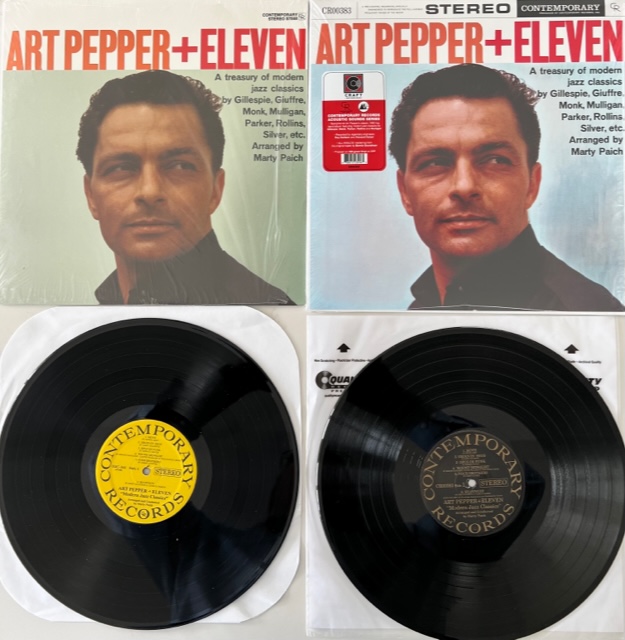
This week, I received a pre-ordered copy of “Art Pepper + 11” from Craft recordings, mastered AAA by Bernie Grundman. This is my third version – the first is a 1974 Japanese reissue that sounds pretty good, but a bit dull. I then bought a OJC version in 2014 ($20) – and it was brighter and more engaging but a little harsh. And now – drum roll – the “new one” (€35). First impressions – the cover is a decent tip-on reproduction of the 1959 original (the back is like a later Contemporary reissue), black labels (no DG unfortunately), poly lined inner (great), standard 180g pressing – at QPR. Sound – excellent – but, dull at the top end, as if somebody had put on Dolby noise reduction. Nice product – perhaps missing just a new inner sleeve with an essay.
If you are building a record collection and you want audiophile sound and you want it to gain value – you must pay attention to all of these details. In my view Kevin Gray is better than the onsite mastering engineers at Optimal, RTI is a better pressing plant than Optimal, Optimal is better than GZ etc. More importantly, anyone who works in a record company that owns analogue masters and puts out vinyl records MUST know this and know what their customers know (see follow up article on the Marvin Gaye mess). There is absolutely NO excuse for using digital sources for album re-issues if the original metalwork is available (see ECM) or if the analogue masters are in good condition (remixes like Steven Wilson’s and Giles Martin’s are different products entirely) unless digitalisation enhances the sound quality (the slightly unconvincing argument for modern 1/2 speed mastering).
In the next few weeks, Rhino will re-issue deluxe editions of two of the greatest jazz albums – “My Favorite Things” by John Coltrane, and “Art Blakey and The Jazz Messengers with Thelonious Monk” (both $35). These will be presented in nice jackets with an extra album of outtakes – but nowhere will you find the provenance of the recorded material. They may claim: “Sourced from the Original Master Tapes” – which means absolutely nothing – as I have several CD copies of each one that were sourced similarly – and could be used as direct lineage source. Moreover, AAA reissues of these records have been released recently – MFT in mono, from the Electric Recording Company (that will cost you a month’s wages) and Monk/Blakey in 2016 by Analog Spark – mastered by KG. You might choose to buy these; I may well do so myself. The records will sound very good (all of the Rhino Atlantic reissues sound good), they are priced reasonably, and there is added value – an extra album. But what you are buying is a series of high res files pressed on vinyl (even that is not guaranteed). Similarly, the recently reissued “Trio” by Charles Mingus and Hampton Hawes – is packaged beautifully – with a bonus disc at an affordable price: all you will find is generic number stamps from Optimal in the dead wax (presumably mastered in house from 24/96 files). Are these albums worth the price?
And what about digitally sourced vinyl. By this I mean primary digital recordings cut onto vinyl records. This would seem, on the surface, pointless and oxymoronic: why not just stream the album in Hi Res from Qobuz. Bizarrely, sometimes (not always), digitally recorded material can sound better on vinyl, due to a different approach to mastering (less compression), and differences in the playback chain (avoiding wow and flutter, clock errors etc). “Valentine” by Bill Frisell is one of the best sounding records that I have ever bought; it was recorded digitally. I recently acquired, at significant cost, “From Birdland to Broadway” – a 2021 reissue of a 1996 digital recording by Bill Crow originally released on vinyl and CD that year (and later on SACD). The re-issue, on the Japanese label Venus (Hyper Magnum), as part of an audiophile vinyl series, sounds extra-ordinary. Every aspect of the recording, mastering and pressing chain is labelled. There is an obi, and insert and poly lined inner sleeves (although the cover reproduction is a bit blurry). These records, if you can get them, cost €54 and above. Are they worth this price?
Pat’s Record Price Calculator (New Releases and Reissues)
So this is how I would price things up when entering the “audiophile market” (I am using dollars here, which, taking tax into account equates to Euro – subtract 25% for £Sterling):
- Base price of album – regardless of source: $20
- Mastering
- Unidentified + $0
- Identified (non-premium engineer’s initials in the runout groove) $1
- AUDIOPHILE≠ Upgrade: + $5 if any of the following:
- AAA (indicates premium engineer – only the best can cut AAA these days)
- Mastered by Kevin Gray or equivalent known premium engineer (if not AAA and original analogue master tapes are unavailable)
- ½ Speed Mastering (including the engineer)
- Mastered from Original Multitrack Masters (including the engineer e.g. Steven Wilson)
- Pressing
- Standard: United, Record Industry, MPO, GZ or other: + $0
- Upgrade
- Middling: Optimal, Third Man etc: + $3
- Premium: Pallas, QRP or RTI: + $5
- Dressing
- Standard: Single record sleeve, Paper inner, No Insert: $0
- Upgrade
- Polylined inner sleeve (or printed inner): + $2 ($3 for both)
- Stoughton tip-on gatefold jacket (or equivalent): + $5
- Single tip-on jacket: + $3
- Gatefold: + $3
- Booklet or Insert with original essay(s) + $3
- Premium Features
- No Premium Features + $0
- Upgrades
- 2nd Record (base price): + $20
- 45rpm (per record): + $5
- Deluxe Pressing (One Step etc) + $5 per record
- Supervinyl or SRX or equivalent: + $5 per record
- Big Unnecessary box containing foam: + $30
- Limited edition/numbered etc: + $10 (but this increases exponentially the “rarer” the record is.
- Add 25% more (including shipping) if you are importing from Japan, the USA or Canada (or anywhere for that matter) into Europe.
- ≠ Please note that “audiophile” can ONLY mean that the record was carefully mastered (preferably from the original analogue masters) by a well known engineer with a reputation for superb mastering. Digital sources are ok if the engineer is exceptionally skilled (e.g. the Mobile Fidelity Silver Label Series – mastering and lacquers by Kurt Wunderlich). Records should be pressed with a low noise floor on quality vinyl. It doesn’t matter if the record was pressed on 250g of virgin vinyl, in a hand painted jacket and a hardback book – audiophile is all about the sound which depends on the quality of the source, the mastering and the pressing.
Using this approach, let us look at 4 different “audiophile” records reissued recently:*
- Random BN Tone Poet: $37 (Base 20, AAA (KG) 5, Poly 2, RTI 5, Tip on 5).
- Art Pepper + 11 Craft 2022: $32 (Base 20, AAA (BG) 5, QRP 5, Poly 2)
- Cannonball Adderley (MOFI one step): $132 (Base 20×2 + 45rpm 10×2 + Supervinyl 5×2 + Onestep 5×2, Mastering 10 + Poly 2, + RTI 5 + Unnecessary box 25 + Ltd 10)
- Roxy Music “Stranded” (2022): $34 (Base 20, ½ Speed 5, Optimal 3, Gatefold +3, Poly + inner 3)
For new releases, you can add $10 for a second record, $5 for coloured vinyl, $5 for limited edition, $3 for a gatefold sleeve, download code: $2 MP3, $3 if WAV/Flac; $4 for 24 bit, $5 for DSD or a CD. Hence, a single LP – black vinyl, pressed at GZ in a basic jacket and inner sleeve and no code, should cost about $20. An limited edition double album pressed on coloured or clear vinyl in a gatefold sleeve (independent retailers), may sell for $45. Indeed, while in the record shop, one might balk at the $10 premium for the limited edition version, be aware that these albums go up in price – sometimes quite spectacularly. For example, “Honeymoon” by Lana Del Rey was released on vinyl in 2015, and no longer easily available. If you bought the standard black vinyl version, and kept it in mint condition, you can sell it for, maybe $40. If you bought the red translucent version, you can sell it for $200 to $300. I’m not saying you should buy the “deluxe” version (the black vinyl version may sound better) – I am just giving you an idea of the economic thinking behind pricing.
Most music fans don’t have super mega high end hifi setups and may struggle to hear the difference, if there is one, between the new expensive audiophile release and a less expensive earlier reissue. Keep in mind that master tapes of 1950s jazz records are now more than 60 years old. The Kind of Blue Master in in appalling condition, that is why Analogue Productions used twenty year old metalwork from Classic Records for their recent expensive reissue (I reviewed this a few months ago), in an ugly unnecessary plastic box. Contemporary records kept pressing their catalog using the original (or newly cut AAA) metal parts up until 1984. These often sound as good, and in some cases better (newer lathes) than the original pressings.

As a final aside – are Vinyl Me Please (VMP) releases worth it? VMP releases retail at approx. $40 per month (including shipping) – so I am going to assign them $35 (without shipping) – which would seem reasonable. This month VMP are releasing “This is Phineas” by Phineas Neborn Jr (an album that has been available for a while AAA from Speakers Corner – similar price range). One of my favourite things about VMP is their obsession with provenance. By looking at the release page one case glean the following information:
Reissue ($20)
Original Mono Masters
AAA Laquers cut by Ryan Smith Sterling Sound (+$5)
Plated at RTI but Pressed at GZ
180g (standard these days)
Tip On Jacket (+5)
Poly Lined Inner Sleeve (+$2)
Essay or Book (standard at VMP) (+$3)
Total value = $35. Cutting the acetates at RTI probably adds $2-3 in value. Regardless, VMP seems to be pretty good value for money. Unfortunately, they seem to have access to a limited library of titles, and, if you subscribe, you can end up with a very limited range of “swaps” if you don’t like that month’s product (and you end up paying a “good value” $40 for a record you don’t really want!).
Footnotes:
- Although digital recording dates from about 1981, it was not widely available until the mid 1980s. In fact, companies such as Sony advertised on vinyl records “digitally recorded” as if this added some super special deluxe aspect to the process. Nearly all records were mastered from tape up until about 1990. This includes “digital recordings” that were transferred to tape to be cut onto lacquers. Technically these are “original master tapes” and that makes the provenance of a lot of records from that era (e.g. “Brothers in Arms”) very confusing. The OJC (Original Jazz Classic) titles were released by Fantasy records (Riverside, Contemporary and many other labels) in the 1980s as mid price reissues on both CD and vinyl. From the current perspective one would assume that the album was digitalised and then the lacquer was cut. But that madeno sense in 1986 – mastering engineers worked principally from tape in those days and digital workstations (ProTools) did not exist. It would be much more likely that the lacquers were cut concurrently as the album was digitalised. Indeed that is what happens when you buy an Analogue Productions LP/SACD. So the OJC records, for example those mastered by Phil De Lancie, up to and possibly after 1990, are nearly all AAA releases and sound great.
The 2000s and 2010s OJC reissues (Bill Evans, Art Pepper etc.) are of uncertain provenance – I have absolutely no idea whether they used old metal parts, new lacquers cut from digital or tape etc. Regardless all of the releases that I have bought sound great.
 audioexchange
[…] and various other paraphernalia into a box that costs twice as much as the contents combined value (see my last post – the “super-deluxe” box with unnecessary foam adds at least $30 to the price, […]
[…] – be aware that this is 1 x 33rpm not 2 x 45rpm and they are pressing up 40,000 copies. Using my calculator from earlier this week (see bottom of page for a repeat): $20 base price, Audiophile AAA +5, […]