
I never bought “Thriller”
but, I’m told that 100 million others did (or perhaps 25 million bought several different versions of it). The record, by Michael Jackson, before he turned into….I don’t know what…completely changed the record industry, changed the sound of music, massively boosted MTV, made popular music color blind (for a while), created the concept of pop megastars and introduced us all to moon walking. I never bought it. The music was ubiquitous for about 2 years. Every song was a single. They were all good. Hearing the songs transmits you to another time, another era when we were deep in the cold war, Russia was a menacing belligerent presence, there was rampant inflation, Liverpool were the champions of Europe, the Rolling Stones were touring and “All Creatures Great and Small” was on TV. Hmm maybe things have come full circle.
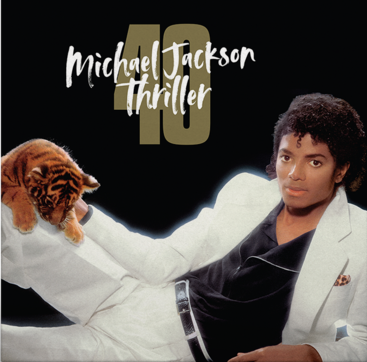
Anyway, if you are a fan of “Thriller” and you can choke down your distaste for Jackson’s lifestyle, his demise and the allegations against him – then you are in for a bumper time over the next few months as a whole slew of “40th Anniversary Thriller” material is released: intially CDs and DVDs but surely – if the market will bear it – some spectacularly expensive Super Deluxe Box Set. As I mentioned previously, you can spend €58 on a standard (i.e. digitally sourced) copy of the record in an alternate cover. Unfortunately this doesn’t involve the tiger cub savaging Michael – although the cub seems to be having a nibble at his leg – and Jackson is looking anxious.
Of more interest is the MOFI One Step version of the album – cut at 33rpm (thank goodness) on supervinyl, AAA from the Original Master Tapes. Price: $100 or €110. While this may look inexpensive compared with the standard One-Step products – be aware that this is 1 x 33rpm not 2 x 45rpm and they are pressing up 40,000 copies. Using my calculator from earlier this week (see bottom of page for a repeat): $20 base price, Audiophile AAA +5, Premium Pressing +5, Supervinyl +5, OneStep + 5, Polys + 2, Gatefold +3, Big unnecessary box +30, Limited edition +10 Value $85. So it is too expensive. But it is a super-audiophile version of one of the greatest albums of all time, that was extra-ordinarily well recorded for the era (i.e. drums that actually sound like drums).
I have been bothered all week about how they are actually making these vinyl records. The conventional approach to making records is to cut a lacquer from the master tape or digital file (GZ specialize in direct metal mastering – so that skips a step or two). The lacquer can be played (known as an acetate) on any record player. To be able to press records one needs a stamper that is a negative of the lacquer. As, most of the time, you want to make large numbers of records, a mirror of the stamper is made (the father), from that a metal replica of the stamper (the mother – or direct metal master) and from that a mirror image stamper is made. The stamper is used to press records and it eventually wears out. If you have the father or the mother you can make unlimited stampers (this is often termed the “original metalwork”). The issue, of course is that if the lacquer is effectively a photocopy of the tape, the stamper is a photocopy of the photocopy (2 generations removed).
The “One Step” process involves making a series of lacquers (not just one paired set) that are essentially turned into the the stamper: they call this a “convert.” There is no father and no mother. It seems to me that each lacquer can only be used once to produce the convert. The convert-stamper can only be used once to produce – who knows 500 to 1000 records? Consequently you are pressing up the photocopy directly, and it should sound better. I have a few of these products (2 x 45rpm) and they do sound really good, despite the big box and need to flip every 7.5 minutes.
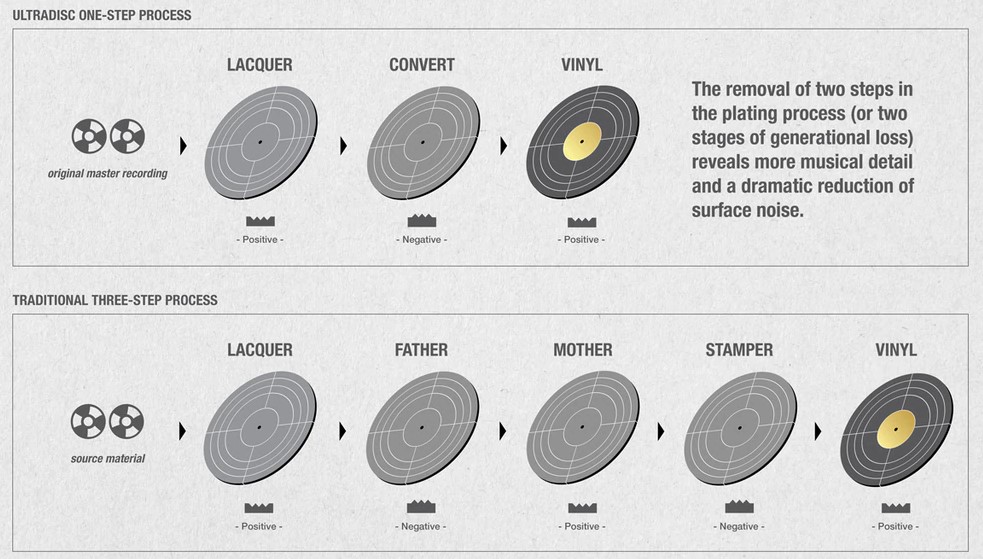
What is bothering me about this release is the sheer number of lacquers that will be needed and their quality. Conventionally a mastering engineer like Kevin Gray or Bernie Grundman will cut a pair of lacquers for an audiophile release with extreme care and precision. That pair of lacquers (one for each side) can be scaled up exponentially. The records may be pressed up 1 million times until the father-mother combo wears out. However, in the One Step process, for every 1000 albums (at the most) there must be 2 lacquers cut (one for each side). To cut for 40,000 copies – taking into account spoilage and test pressings – you are looking at a mastering engineer cutting at least 100 and up to 180 lacquers. That is a lot. But there is more. To use the “original master tapes” to produce this album, each lacquer must be cut from the tapes themselves – NOT copies of the tapes. Think about that: does anybody believe that Sony are going to give Mobile Fidelity (a separate record company albeit with a stellar reputation) the most valuable master tapes in the history of music to run through their tape machine dozens of times? No way. These numbers cannot be done with original tapes using lacquers or direct metal mastering. They could easily be done digitally, obviously, or with copies of the master tapes – in which case no one-step. Mobile Fidelity really need to explain this – and most of my assumptions above may be wrong if the lacquers can be reused – but I am of the impression that like any fragile mold, they can be used but once. It is quite possible that Sony have constructed as series of new “master” tapes from the multi-tracks, but these are not the “original” masters.
You might ask – did Analogue Productions not do something similar with “Kind of Blue“? No – while AP did use Superflat-Supervinyl using some kind of artisan pressing machine – the metal parts were recycled from the Classic records version (the original masters are no longer usable). Indeed, these metal parts were from the “Original Master Tapes” – unlike the MOFI version, that came from the 1997 master. The Nightfly by Donal Fagen was release by Mofi as One-Step (original master recording) despite being a digital recording, transferred onto tape for vinyl mastering. Again, this was never adequately explained – did they make a master from the digital sources or did they use whatever tape was used in 1982 to call it “the master tape?”
I still haven’t bought “Thriller.”
“Off The Wall” – now that’s another story.
APPENDIX – VINYL PRICE CALCULATOR
Base price of album – regardless of source: $20Mastering
- Unidentified + $0
- Identified (non-premium engineer’s initials in the runout groove) $1
- AUDIOPHILE≠ Upgrade: + $5 if any of the following:
- AAA (indicates premium engineer – only the best can cut AAA these days)
- Mastered by Kevin Gray or equivalent known premium engineer (if not AAA and original analogue master tapes are unavailable)
- ½ Speed Mastering (including the engineer)
- Mastered from Original Multitrack Masters (including the engineer e.g. Steven Wilson)
Pressing
- Standard: United, Record Industry, MPO, GZ or other: + $0
- Upgrade
- Middling: Optimal, Third Man etc: + $3
- Premium: Pallas, QRP or RTI: + $5
Dressing
- Standard: Single record sleeve, Paper inner, No Insert: $0
- Upgrade
- Polylined inner sleeve (or printed inner): + $2 ($3 for both)
- Stoughton tip-on gatefold jacket (or equivalent): + $5
- Single tip-on jacket: + $3
- Gatefold: + $3
- Booklet or Insert with original essay(s) + $3
Premium Features
- No Premium Features + $0
- Upgrades
- 2nd Record (base price): + $20
- 45rpm (per record): + $5
- Deluxe Pressing (One Step etc) + $5 per record
- Supervinyl or SRX or equivalent: + $5 per record
- Big Unnecessary box containing foam: + $30
- Limited edition/numbered etc: + $10 (but this increases exponentially the “rarer” the record is.
Add 25% more (including shipping) if you are importing from Japan, the USA or Canada (or anywhere for that matter) into Europe.
 audioexchange