
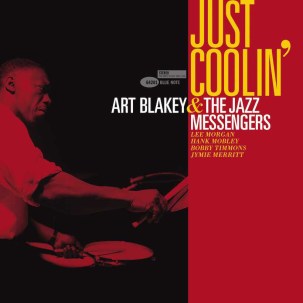
 Such has been the sheer volume of Blue Note reissues over the past 18 months, weary jazz fans may have missed a truly important new release that came out in July – a never before pressed album by Art Blakey and the Jazz Messengers – “Just Coolin'”. The album, that featured a very short lived version of the JM that featured Hank Mobley on tenor (replaced soon after by Wayne Shorter), Lee Morgan on Trumpet, Blakey on drums, Jymie Merritt on bass and Bobby Timmons on piano, was recorded by Van Gelder in March 1959 but was never released (not even on Mosaic in the 1980s). The story is that Blue Note recorded the group a couple of weeks later at Birdland, playing four of the tunes in this studio set, released as “Meet you at the jazz corner of the world” in two volumes (recently reissued as a Blue Note 80) and the perceived superiority of the live versions made the studio album redundant. So, off the shelf have come these pristine tapes (that haven’t been run through machines 100 times like all the other BN albums), with new cover art and liner notes by Bob Blumenthal (it must have been a singular honour to write the notes for an original 1950s Blue Note!).
So, what’s it like? Firstly – recent BN reissues have had two quality levels – the beautifully pressed, gatefolded Music Matters-like Tone Poets, and the extremely variable quality, 140g (sometimes in sandpaper) Blue Note 80s. This album is a hefty flat 180g, in a plastic lined inner sleeve wrapped in a cheap cardboard cover that was dented in creasemarks when delivered to me in a plastic envelope from Amazon (weird right? Often single records arrive in gargantuan boxes from Amazon). Mastered for vinyl (but not CD or streaming) by Kevin Gray, the sound is exceptional for the era. The songs – 4 by Hank Mobley and 1 by Bobby Timmons (plus one of unknown provenance) are exciting straight ahead hard bop originals that will be familiar to those who enjoyed “Meet Me”. The studio versions are shorter, but easily as enjoyable.
This album is great, and strongly recommended. It will sell by the truckload – but be careful – pressed at Optimal (Germany), there will be a few duds out there (I was not impressed with Optimal’s quality control for the first round of BN 80s – it has definately improved with subsequent releases). Finally, I know Art Blakey would have been 100 this year – but 5 releases with another Tone Poet to go this year? Perhaps Don Was might look around at other BN artists – plus those on allied labels (how about “Modern Art” by Art Pepper – that was reissued at one stage on BN – or any of the Pacific Jazz releases?).
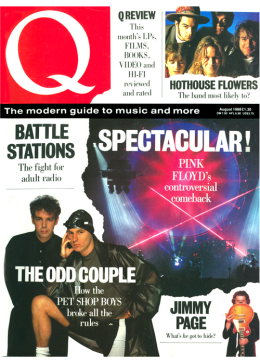 September 1988, I’m browsing through a newsagent in Boston and a magazine catches my eye – “the modern guide to music and more:” Pink Floyd and Hothouse Flowers on the cover of a glossy, full of photographs and jam packed with reviews. It was love at first sight – Q magazine, a UK based music mag that I have bought religiously for the past 32 years. Founded by Mark Ellen and David Hepworth, who had made Smash Hits required reading for my generation (until we decided it was too teenybopper), Q was the antidote to the music weeklies – NME, Melody Maker, Record Mirror, Sounds – which I had grown up with, but, by then was tired of the “cool cynicism” of the reviews, the relentless pursuit of the next big thing (Zig Zig Sputnick – anyone?). Q was great – it carried articles on modern groups like the Blue Nile, Prefab Sprout, the Sugarcubes, Morrissey, U2, Tracy Chapman, REM, Nina Cherry, Bjork, Simply Red – alongside articles about Sting, Dylan, Bowie, Mark Knopfler, the Rolling Stones, Paul McCartney etc. There were reviews of books, movies and hi-fi. Albums received between one and five stars (the latter was a a rare event in the early days; I remember a particularly embarrassing 5 star review of Terence Trent D’Arby’s at best 2 star sophomore recording). There were funny articles such as “who the hell does…..think he is.” My favourite was an article about “euphemisms in rock music” – where terms like “split because of artistic differences” was translated to “broke up over lead singers’ heroin habit.” I still have a pile of those early issues – albeit the music taste now looks a bit staid. The mag was thick – roughly twice the size of recent iterations. Of course, the quality dropped off: the movies were spun off to Empire, and a second, and better magazine, MOJO, picked up the classic rock features.
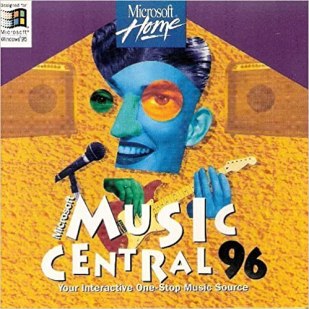 The most valuable commodity in Q was the review section. Because the magazine coincided with the CD era (hence it’s name – cue literally), everything that was re-issued on CD was reviewed. As a result, by the mid 1990s they had a massive archive of reviews. This was before the All Music Guide was fully operational online (it was still in book format then). Microsoft came calling and licensed the reviews for “Music Central” (a CDROM product that sold for about £75) – which meant that you could call up the reviews on most popular recordings on your computer – at home – so convenient!
 (ok so this item is a bit late – written at end of 2019 but forgot to post!)
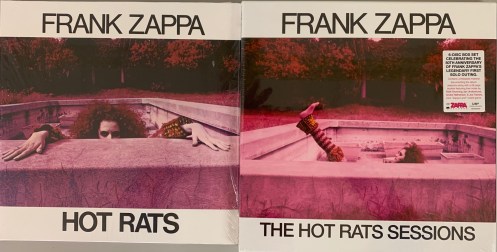 It may have been the grunting vocals, the avant guard sax solos, the thumping beat or the snarling guitars, but I had never heard anything similar and I liked it. It was in Tower records, sometime late 80s or early 90s. In the pre Shazam era, you had to ask the sales clerk – “who or what is that?” – a knowing grin, a nod of approval – “Hot Rats” by Frank Zappa. Tape acquired, inserted into Walkman, and it stayed on continuous play for weeks. The love affair has never faded. Over the years, I have acquired, mostly on CD, all of the official Zappa releases, and a good few of the official bootlegs as well (“Road Tapes”), always hoping to hear a little bit more of the “Rats” magic. In the early years, the encounters were disappointing – albums filled with puerile pop songs, vulgarity (that wasn’t funny) and general weirdness. But sometimes, you hit pay-dirt – or “Sleep Dirt” to be precise. That record, Waka/Jawaka and The Grand Wazoo – all shared the Jazz Rock blueprint. There never seemed to be any “Hot Rats” bootlegs around, with forsaken or demo tracks – but we all knew they were recorded (Zappa never discarded anything). When the “deluxe edition” period arrived, about 10 or 15 years ago, I hoped that we would be treated to the outtakes. Nada. Finally, in the guise of a 6 CD set (“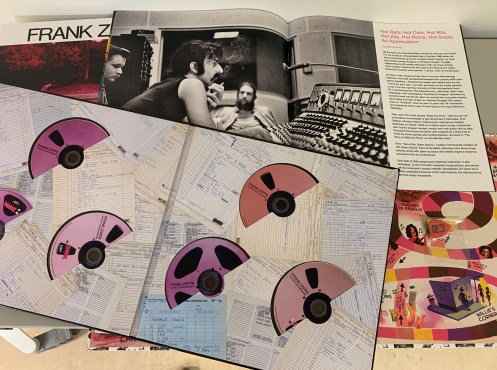
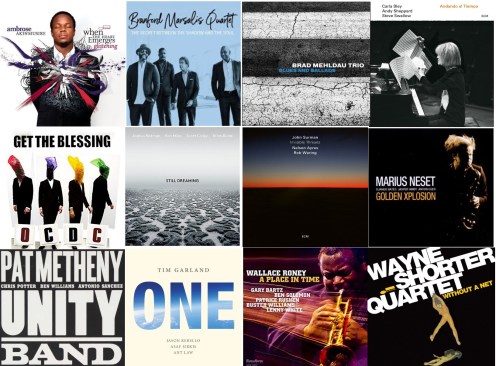 The 2010s was a great era to be a fan of both recorded and live jazz. The re-emergence of jazz as a popular music form has much to do with the collapse of the quality of rock music, a generalized fatigue with hip hop, the preponderance of manufactured pop and the retreat of electronic music to the underground. I’m not suggesting for one moment that jazz has become pop music, but it is becoming economically viable again. Moreover, musicians of all colors, creeds and backgrounds have learned to improvise over their traditional music and traditional instruments to create jazz. It is important to recognize the value of new music and young musicians – they have the whole history of recorded music to draw in, are amazingly well educated, and, in general produce original recordings that they compose themselves. Compare this with a large cohort of “great recordings” from the 50s and 60’s – during which musicians gathered, unrehearsed, for a four hour session and belted our two albums of “standards”. Twenty first century jazz is indeed a different paradigm – it doesn’t swing as much; it is more likely to be ambient or atmospheric and is scripted and sculpted into place.
 I received an email from
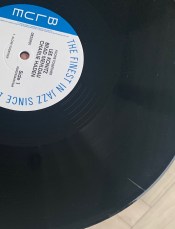 There was a lot of action in the Blue Note vinyl world this year – the much touted Tone Poet series – which was excellent despite the releases emanating from the “lesser” part of the catalog. The Blue Note 80 vinyl series has also sold well – although I have my own misgivings about the quality of the product. I have now returned my fifth record due to quality control issues: in this case as soon as I opened the long awaited
 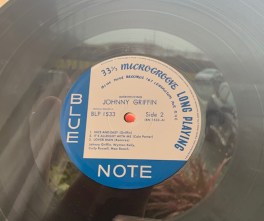 “SRX stands for “Silent Running Xperience.” SRX is our own formula, conceived and developed by Rick Hashimoto of Record Technology and manufactured by NEOTECH. Its noise floor is fathoms lower than any other vinyl we know of out there past or present. Records pressed with it look like normal black discs until you hold them up to the light and see that they are translucent and smoky, silvery gray in color.” [see image to the right – it is indeed silvery gray transluncent plastic]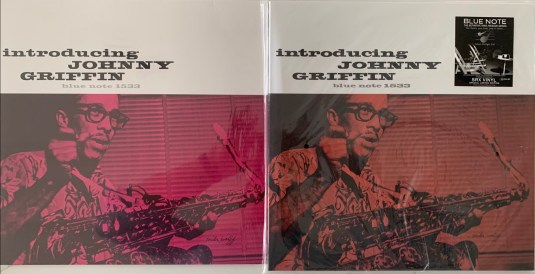
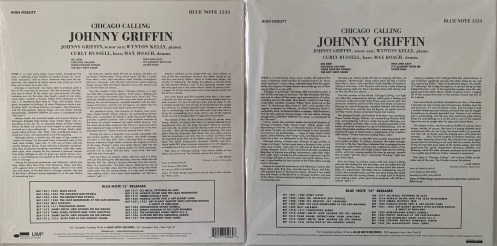
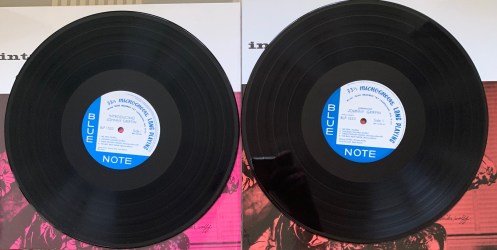
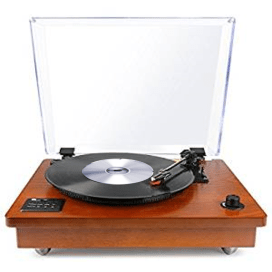 The music industry has been particularly good, over the past 4 decades, at repackaging “catalogue” material into new or new old products and selling them back to us. This started with the compact disc (CD) and the box set, deluxe edition, superdeluxeedition, vinyl reissue, vinyl superdeluxedition and, of course, high res downloads. In between there have been a number of “failed” formats – DAT, digital compact cassette, mini-disc, DVD-audio and Super Audio CD (SACD) – all of which were massively hamstrung by serial copy protection. Mini Disc, in particular, was a spectacularly good product from the era – and it could and should have been the computer drive of choice (rather than, for example, the zip disc) after floppy discs became inadequate. The successful format, of course was MP3, which side stepped the music industry and became the de-facto format of the iPod era (2002 to 2010). With mobile phones and streaming, now, the format is largely irrelevant. Nevertheless, the music industry is still trying to sell new product to the diminishing number of us who like physical formats. Hence, the “vinyl” revolution. The problem, as I have mentioned many times in this blog, is the provenance of the master recording used for the acetates that make the stampers that make the records. Virtually everything that you see in a record shop or online that comes shrink wrapped and bearing a gold and black 180g audiophile vinyl sticker is sourced from a digital file.
 audioexchange