
So Beyonce lip-synced the National Anthem. What amazes me is that anyone is actually surprised. For years pop concerts have been questionably “live”. Where there a highly orchestrated show involving complex dance regimes, multiple costume changes, essential synchronization with lighting and backdrops – much live music is little more than karaoke. In the era of digital recording, auto tune and backing tracks entirely constructed in pro tools – one can fully understand why an artist would not take a chance on messing up a live performance. Virtually everybody is synching their music to a click track. Better to pre-record a perfect track, pitch correct and mime. Nobody complained about miming on top of the pops for decades. So what’s the big deal? Pop music was never about live performance or “keeping it real”, it is about showbiz – appearance rather musicianship.
I would be truly appalled if Bob Dylan, the Rolling Stones, Neil Young or even Mumford and Sons were outed for miming. Brittney, Beyonce or One Direction: who really cares?
Lip sync
•January 22, 2013 • Leave a CommentThe post HMV world
•January 18, 2013 • Leave a CommentThis morning, instead of blowing a wad of money on new releases, I patiently watched Deezer downloading several new recordings into my iPhone. First up I am Kloot – Let it all in. Despite the reviews, much better than Sky at Night (8/10 music, 1/5 loudnes). Matthew E Smith’s album reminds me of Lambchop’s Nixon – I’m thinking album of the year already. (9/10 music, 2/5 loudness). Then there is Lord Huron – Lonesome Dreams: more rustic Fleet Foxes meets the Band (6/10 music – but growing, 2/6 loudness).
I am looking forward to 2 other albums this week: Aaron Neville and Arboretum.
Grade Inflation
•January 17, 2013 • Leave a Comment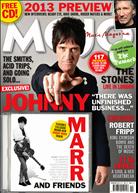 I was just browsing thru this month’s Mojo magazine and read the various album reviews. Of the new albums reviewed – I count 73 (but I got a little boggle eyed so this may be +/- 2 or 3), the reviewers awarded 53 albums 4 stars (8/10) and 20 albums 3 stars (6/10). No albums received 1 or 2 stars. I enjoy reading Mojo, and have read it most months since the first issue 20 or so years ago. But – one of the main reasons for reading the music press is to be alerted to new recordings – particularly by artists with whom I am unfamiliar – that are worth exploring. Like many music fans, 4 stars or 8/10 seems to be a good review and excellent album (5 stars being an all time classic). If three stars represents a good album (average), then either this month’s releases represents an amazing month for music or overall grading inflation for fear of upsetting the artists or the record company.
Looking at the re-issues – there are 40, of which 34 received 4 stars, 1 received 5 (Bessie Smith – great but unlistenable due to lo-fi) and 6 received 3 stars (one of which, the deluxe edition of “Searching for the Young Soul Rebels” is generally agreed to be a 5 star album). To summarize – 116 albums reviewed of which 87 received 4 stars. You might as well read the press releases rather than the reviews.
Why I love January
•January 17, 2013 • Leave a Comment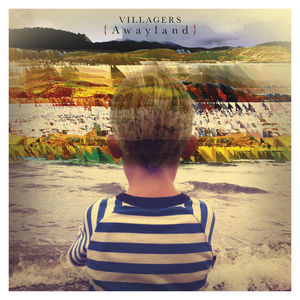 Believe it or not, for several months of the year few new recordings are released. From Nov 1st thru Christmas it is compilation, holiday music and box set season. As most artists wish to spend the holidays at home and not on the road, it makes little sense to release a record that will require a lot of promotional activity. Hence, only mega selling acts, like Bruno Mars, will release new albums during the holiday season. So, for music lovers it – we have an early winter freeze. Likewise, music sales fall off considerably during the summer, and there are few new releases between June and September – a summer drought: touring bands will have released their product in the Spring. The Autumn is often the source of slim new music pickings, as the year begins to wind down.
So, January is always a good month; February is better; and March and April are the peak release months. By June 1st you can safely construct your top 10 list of the year and include 7 titles. So, last week I made (what turned out to be my final trip) for HMV and picked up a few new releases.
[awayland] from Villagers topped my list – a beautifully presented package that included some postcards. The album has not grabbed me yet (6/10 music, 8/10 packaging, 2/5 for loudness and compression] but it is growing. I also bought Everything Everything’s Arc (5/10 music, 7/10 packaging, 3/5 loudness) – not yet growing. Christopher Owens, who was in Girls, has released a wonderful recording – Lysandre (7/10 music, 4/10 packaging, 1/5 loudness) and this is growing rapidly: I particularly enjoyed the flute, sax and xylophone. Similarly, I am enjoying Snowgoose – Harmony Springs (8/10 music) – downloaded from Deezer. Dutch Uncles’ – Out of Touch In The Wild came beautifully presented, is impressively proggy art rock, but not really hitting the mark (music 5/10, packaging 7/10, loudness 2/5).
From Pitchfork: Dutch Uncles stick to a rigidly pointillist, exacting scheme of glassy, Reichian xylophone and marimba, Talk Talk-y guitar ticks, and choppy Stravinsky-inspired string sections, for a prismatic take on herky-jerky pop that approaches complex situations like a beguiling data visualization.
Interesting that the NME slagged off the sax in Christopher Owens’ album as a sound “not heard since 1986” – I must blog about the disappearance of the saxophone from popular music. Rolling Stone “he nails a Seventies-singer-songwriter sound oozing treacle and sincerity, all folk guitar, flutes, supper-club saxes and vintage keyboards. It fits the concept: a loosely autobiographical musician-in-love song cycle.” LA Times: “the record, which was allegedly written in one fevered day, skips off into Bill Withers acoustic ambience, Belle & Sebastian-style twee-pop and occasional nods to acid-casualty classic rock.”
Why I don’t get iTunes
•January 17, 2013 • Leave a Comment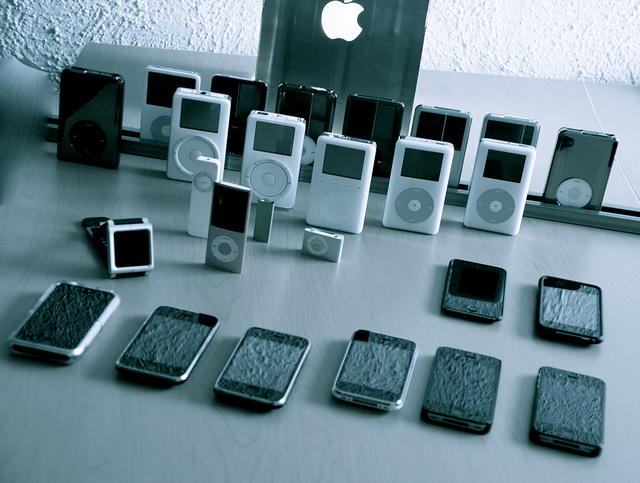 My family seem to have a lot of iPods – going right back to the first generation. Having lived with cassette walkmans (you had to carry a bunch of tapes in your backpack, CD walkmans (didn’t exactly fit in your pocket) and early MP3 players (wasn’t a lot you could fit on a 32mb Rio) – the iPod (originally 5GB) was a godsend. Everything about the original iPod was cool – and you could carry around a pretty large music collection and listen to whatever you liked. I tried other music players over the years – Cowan, Archos, Sansa, but the iPod was always the best. Once album art was displayed – bingo! I never quite saw the point of the shuffle.
Back in the late 1990s I digitalized my CD collection (and indeed some cassettes) to MP3 – so I was an early adopter. When the iTunes store opened (followed by lots of similar WMA stores), I didn’t quite get it: the music was limited by Digital Rights Management. Why would you want to buy a product that you clearly did not own: if I buy a CD or vinyl record – I can sell it to a second hand shop. Soon after emusic.com opened – selling VBR encoded MP3s at good prices, and they allowed you to re-download if you lost your files due to negligence, hard drive failure or accidental deletion. [unfortunately they subsequently increased prices and got rid of re-downloads so I gave up on them]. Along came Rhapsody – which allowed you to stream anything you liked to your computer – they subsequently allowed you to rent music to an portable audio device (usually some WMA certified gadget) and this opened up another paradigm. So, after a decade of digital music stores – where do I stand?
These days I never ever buy compressed music. I do buy music from HDTracks (24/44-88-96) – but that is the only real current source of high resolution. I have never made a purchase from iTunes. Ok, I have bought lots of CDs/DVDA/SACD and Vinyl over the last decade, but I can’t help feeling that nowadays iTunes is for suckers. Now that Deezer, Spotify, Rhapsody and others allow you to download unlimited amounts of “rented” music to your iPod, iPhone, iPad, android device or computer – and you can stream – really everywhere in reasonable resolution – what is the point of iTunes? Modern pop music is disposable – what you buy today you are likely to grow out of next year. If you are so attached to an album that you cannot live without it, surely a physical CD is better value than an iTunes download. I have not listened to music radio for years, because where I live commercial radio is crap pop music and moron DJs. But Pandora – this is the future: tailored radio for your mood and taste. Online and cloud computing is clearly the future – with little or not local content. Just as cars were slow to obtain tape and CD players, and mp3 playing capabilities (and satellite radio is very limited), soon all cars will have broadband, and a Pandora like service is the way to go. A siri like voice activated interface that you could instruct: “play me music like Steely Dan” or “80s Chicago house music”.
I have a suspicion that the retail wars are just starting: yes HMV and all the record shops have been killed off by iTunes; yes Borders was butchered by the Kindle – but really, these are just 21st century versions of 19th Century retail. Who really wants to own non physical products? Aside from reference books, I find the whole Kindle thing a bit strange. When you look at your “cloud” and see all of these crappy books that you or your family once downloaded but have no interest in ever reading again you have to think of DVD box sets. Once you have seen a series of 24 – you will never watch it again – you would have been better off renting the series than having to store the box in your home (or fob it off on a relative). Novels, movies and TV series are temporary entertainment diversions – that is why we go to the movies, watch TV or go to the library: owning a product (unless you really love it) is only necessary if you cannot borrow it. The only issue is pricing: how much is a book worth if it is only going to be read once? Or a movie? Or a tv box set? Clearly Netflix are on to something with their business model (although I don’t know how profitable it is). It is a great way for tv companies and movie studios to milk the back catalogue – and make no mistake – BOX sets – that great DVD boon of the noughties is a dying business. Just like audiobooks on 12 tapes or CDs are pointless when you can download the book into your iPhone from audible, similarly the on demand model of Netflix is a real winner.
If I owned Apple stock, I would sell it immediately. I am concerned about their business model:
1. For all of the reasons I have listed above, if iTunes does not introduce streaming and renting, that business will die rapidly.
2. Their products:
a) I had the opportunity of buying an iPad Mini this year. I obtained a Nexus 7 instead – it was half the price, plays flash websites and has a file manager. If I lose it – I am not throwing away a week’s wages.
b) They need to integrate the mac with the iPad – the MacBook air’s screen should detach and act as a tablet. Apple had a 5 year operating system lead on Microsoft when Windows 95 came out and destroyed Apple’s market share. Apple had a similar lead over Windows Vista and had an excellent tablet. Now Win 8 laptops with detachable screens are appearing all over the place. Make no mistake – people are pissed off with the closed Apple system and lots and lots of folks want a fully functional laptop (where they have complete control over programs and content) and a tablet in one product. The Asus transformer was a nice product, but once Win 8 gets it’s act together (am not sure about the RT version), it is going to dominate the market. Very soon people will be thinking “my laptop does everything a tablet does (and more), why would I need to spend $700 on a new iPad. The 10″ iPad is DEAD and the 7.8” device is pricing itself out of the market. Once the coolness factor goes (and the iPad really isn’t cool anymore – my 78 year old dad has one), premium pricing will have to follow.
c) Despite all the Apple hype – Android is the market leading smartphone operating system. Moreover, since the Galaxy S3 – nobody thinks the iPhone is cool anymore. It now comes across as a “sensible” rather than chic option, and aside from the Apple cult, unless there is rapid product development in the next 18 months, Apple will become the new Nokia or Motorola.
3) The Business: I have an iPhone and iPad because I bought an iPod touch – I was familiar with the interface. Kids growing up with android smartphones will stay OS loyal and that market dominance will be reflected in a drop-off in iPhone sales and with it Apples profit drivers. As profits fall, and they will, stock value will fall (as it is overpriced) investors will clamour for a change in management, new products will be rushed out – but now with the elegance of the Jobs era, and it will be 1997 all over again. We have yet to see an innovative product since Jobs’ death. One has to wonder…..
So what should Apple do?
1. Stop the premium product obsession – the Nano is inexpensive and great. Bring out an inexpensive iPhone and challenge android for the lower end of the market. Just give in on the flash issue.
2. Turn the next MacBook air into a combined PC and tablet and drop the 10 inch iPad.
3. Cut the price of the Mini by 25% and stop ripping us off on memory upgrades.
4. Come up with an iTunes version of Pandora (or just buy the company), and bring in streaming and renting (they already do limited time renting for movies).
5. Beware of hubris – Borders, Circuit City, Virgin, Nice Price, Sam Goody, HMV etc. all big name entertainment retailers that are no more. Sooner or later that music industry will come up with a quality alternative to iTunes – it takes only 1 genius to change a paradigm (who would of thought of Facebook 10 years ago).
6. Get with the programme – we need 24 bit audio support, uncompressed downloads and the ability to play back Flac files from iTunes. (admittedly, these are personal requests).
long slow inevitable death of HMV
•January 14, 2013 • Leave a Comment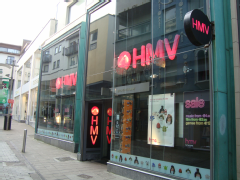 The news that HMV has gone into administration is devastating. For many of us HMV was the last record shop standing. When the stores close there will be, essentially, nowhere for buyers to puck up and buy CDs in many major towns and cities. The music industry, the major creditors are very foolish to let it go. With crappy quality downloads now dominant force in the industry, Apple will have a monopoly on music retail. I will be forced to buy my music from Amazon. the great pleasure of digging thru racks of CDs and records will become a memory or an intermittent treat.
Having witnessed the end of Tower records, Virgin, Nice Price, Strawberries, Sam Goody, Golden Discs and dozens of favorite record shops all over the world, along with Borders book shop, I feel very sad indeed. Going into town will just be a boring experience of walking past lousy boutiques and shoe shops. Truly the end of an era.
Update: the Irish company went into receivership this week and the door are shut, so it looks like my last ever new purchase in HMV as we knew it was Everything Everything’s ARC. Bummer – I was really looking forward to the new I am Kloot album this Friday.
Why is HMV gone? It is fairly obvious – nobody under 30 owns a CD player, Netflix and downloads have hugely devalued CDs and the market for personal electronics is saturated. HMV was a shop that catered for those of us who grew up browsing for music; frequently I went there and could not find the new releases that I was looking for. Our store did not carry vinyl. If your ordered something, it could take weeks to arrive. With Amazon Prime, even instant gratification was lost. On the other had, they often had great value sales, and CDs and DVDs were frequently less expensive to buy than the highly compressed (and copy protected) versions on iTunes.
The Loudness War
•January 9, 2013 • 1 CommentI have been wondering why several highly lauded records have not done it for me last year – particularly Sleigh Bells “Reign of Terror” and Alt-J’s – “An Awesome Wave.” Strangely, I heard the latter in a record shop when it came out first, and really liked it. But, having bought it, I went home and listened thru headphones and grew really fatigued with it after 3 or 4 tracks. This form of listening fatigue has become a problem for me with CDs over the past decade or so: I can listen for hours to anything recorded before 1995, anything on ECM records and most classic rock. But a lot of modern rock records are hard to listen to thru headphones (I usually just plug my B&W P5s into an old Sony Discman). Why is this?
Of course the problem is the persistence of “The Loudness War” a phenomenon that started with Oasis’ “What’s the story – morning glory” where so much dynamic range compression was used that the album sounded like a “Brick Wall”. Back in the 1970s amplifiers had “loudness” switches that pumped up the base and filled out the sound, and I must confess that I enjoyed the phenomenon – better a fat rather than a thin sound. In fact, when CDs came out first (and indeed SACDs) I found that I had to turn up the volume to get a fat sound, as they were often mastered at low levels – presumably to take advantage of the quietness of the format: however low level mastering leads to lower resolution digital output and a dissatisfying listen (the quieter the recording the fewer number of bits are used). Hence, in the early 1990s, dynamic range compression (DRC) became universally used in mastering CDs – particularly classical recordings – where the DB range between quiet and loud parts is frequently enormous. When the CD became the de facto sound carrier in cars DRC became essential, as drivers didn’t like having to continually re-adjust their volume controls when the quiet part of songs came on. These 1990s remasters were excellent recordings because mastering engineers pushed up the volume so that the loudest parts of the album would just about reach the limit (the red zone), and then a little compression fattened up the sound. And then along came Oasis: much of their albums were recorded well into the red, resulting in loudness, harshness and echoey sound. I think that is the reason why their first two albums never became firm favorites of mine – great songs but hard to listen to. Nonetheless, in noisy environments – pubs, shops, workshops etc. the music could penetrate and be heard, and the album shifted millions of copies. The floodgates opened – all young bands wanted their records to sound LOUD – so that they would have the Oasis effect on radio. When the Red Hot Chili Peppers released “Californication” 2000, critics gushed praise all over it. It won lots of album of the year awards. I hated it. I couldn’t listen to it. I did not know why; it just sounded wrong! I now know that this was one of the loudest albums ever released.
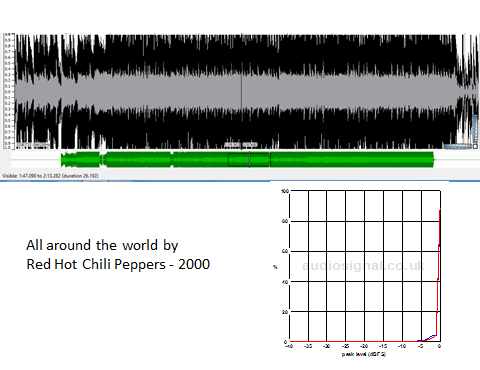
Back in the 1980s I bought a couple of Led Zeppelin albums on CD – this was a serious expense for me because at the time CDs cost £16/$16 and I was expecting “Perfect Sound Forever”. I put the first disc – I think it was “Houses of the Holy” into my CD boombox and pushed play: it sounded – awful. On the same device I played the cassette tape of the same CD – it sounded so much better. Several years later Jimmy Page remastered the entire Led Zep catalog and released a wonderful greatest hits collection – “Remasters.” Great sound, great songs. More recently, and unnecessarily, “Mothership” was released. And it sounds – awful. Where everything on “Remasters” was crisp, dynamic, exciting, detailed everything on” Mothership” is overblown, flat, tiring to listen to and extremely LOUD. It is like Led Zep trying to sound like Muse: unfortunately these are not new recordings; Led Zep should be sounding like Led Zep.
Possibly the most irritating phenomenon is the “newly remastered” approach. The Rolling Stones catalogue, like Led Zeppelin’s, was released on CD in the 1980s. Unlike, Led Zep, the original CDs were derived from the original master tapes, and should have sounded good. Having been told, since I was a toddler, that “Exile on Main Street” was the Greatest Album Ever (Q magazine), it had to be one of my first CD purchases. I listened to it 3 or 4 times – but just did not get it. Muddy sound, no clear instruments, couldn’t understand the vocals: the guys must have been doing some serious drugs in the 1972 in France. However, in 1994 Exile, plus several of the 70s albums, was remastered on Virgin records, by Bob Ludwig, and I took the plunge. It was a different album – “now I know what Mick Taylor did in the Stones”, clear voices, great range – wonderfull. After this, all of the 1960s albums were remastered into SACD hybrids by Ludwig, and the CD layer on each was a pleasure to listen to (unfortunately nobody ever came up with a portable SACD that you could plug your headphones into). In 2009 everywhere you looked there was hype – a new set of Rolling Stones remasters was coming out (principally because they had changed label) – culminating in a deluxe edition of Exile. Well, of course, I had to have it. Bad move – suddenly, this great record started sounding, well – awful – again. The reason – DRC – LOUDNESS. Some genius at the record company decided that the Stones’ 70s recordings (they recorded in the best studios during the best time in history to record on 24-48 track analogue boards) did not sound “modern” enough for the iPod generation. So, they were mastered super loud: cue drone, drone, drone.
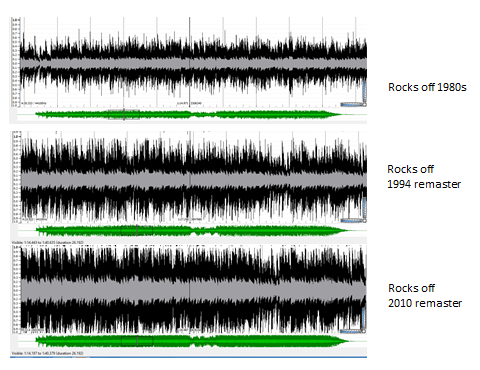
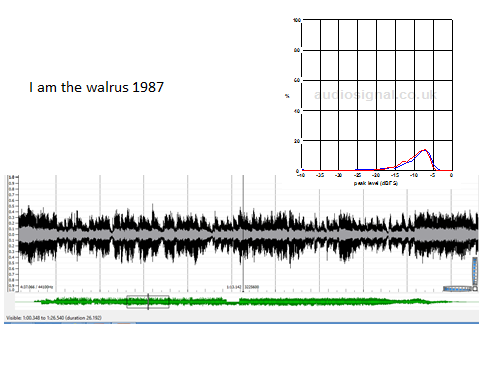
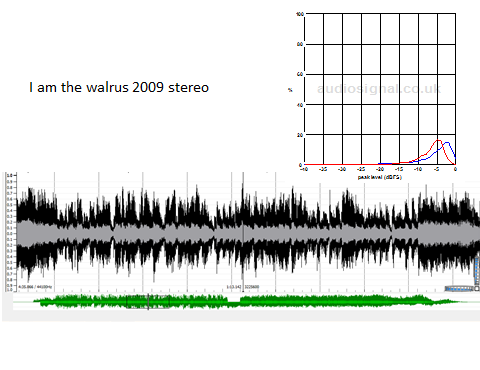
Is DRC ever well done: yes it is! The recent Beatles remasters are an example of how to do DRC correctly. I have all of the original 1980s Beatles CDs; and they all sound pretty good. Being a complete sucker, I bought both the Mono Box and most of the stereo albums and the USB 24 bit high resolution edition of the remasters. The mono remasters have moderate volume, certainly compared with the 1980s versions. The stereo versions (both 16 and 24 bit) used DRC, and increased the volume significantly – but not enough to brick wall the recordings – they now sound vibrant, engaging and fun – but not fatiguing; I like the stereo remasters very much.
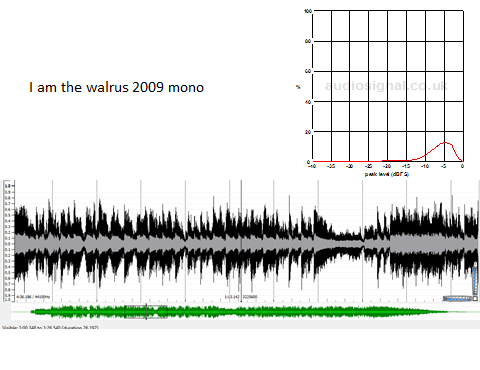
One of the side effects of DRC is that I cannot listen to popular radio anymore. Radio stations always used DRC and loudness; again this appeals to people in cars who have to deal with a lot of cabin noise. All pop records have loud bass and drum tracks, heavily compressed and auto-tuned vocals: they sound truly awful, particularly when doubly compressed by the radio station. Unfortunately, with DRC, this phenomenon is also a problem with rock recordings. When I turn on pop-rock stations, I feel my senses being assaulted: I want to relax while driving – not feel like I need to drop E at a rave.
The worst outcome from DRC is clipping – where the sound is audibly distorted and dissonant due to excessive loudness. The majority of modern recordings avoid this, due to at least a little care during mastering – the audio is loud – but not clipped. However, a couple of highly praised albums from last year fell into this trap:
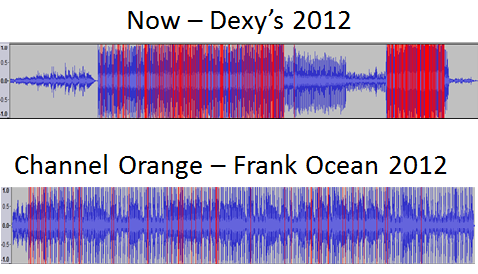
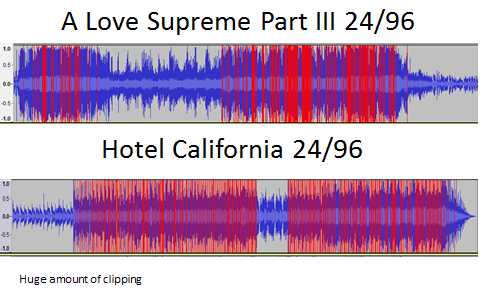
One of the purported advantages of 24bit mastering is the increased “head room” associated with the wider dynamic range. Head room refers to a situation where an engineer is recording a concert, for example: the recording levels are set at the beginning hoping that the quiet and loud parts will be captured without “going into the red”. Recording too low leads to loss of detail; too high – clipping. In the 24 bit realm – there is a huge amount of head room, so clipping of high resolution recordings is, frankly, a criminal offence for mastering engineers – dare I say it – incompetence. So you will understand my horror when I discovered significant clipping on a couple of high res tracks that I had downloaded from HD tracks (see a Love Supreme Part III and Eagles – Hotel California below).
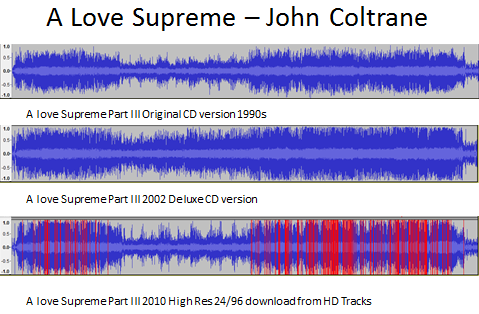
A Love Supreme is one of the great jazz recordings, a Rudy Van Gelder Impulse Masterpiece – I have 4 or 5 versions of this – on CD/deluxe Edition/Vinyl/Tape. Out of curiosity I examined a couple of other versions from my media server. The first was from a cd reissue from 1995. The second is the 2002 deluxe edition remaster – you can see that it is significantly louder – but there is no clipping. The 3rd is the 2010 HD-Tracks 24/96 download – there is clipping all over. I am not sure what the source of this version was: a new CD remaster was released in 2008, which I did not buy and the accompanying liner notes are from that version. Irrespective – the high res download is a disgrace. Listening to the 3 versions – the 1995 version is very poor – muddy, lacking in dynamics and detail; the 24 bit version is a little better, certainly smoother, and I cannot hear noticeable clipping to be fair. The 2002 CD version is by far the best – clear, good soundstage, great separation and dynamics. Interestingly, having done this comparison I came upon this article: click here. It turns out that the original masters were binned and the original 1980s and 1995 releases came from second generation masters. The deluxe edition came from a UK production master – so it is the best version available. Presumably the 2003 SACD came from the same source. It is unclear where the 2008 version came from (no provenance in the liner notes), but HD tracks mention a “recently rediscovered first generation master tape.” That is what is mentioned on the Verve music group website which is selling the 2003 version.
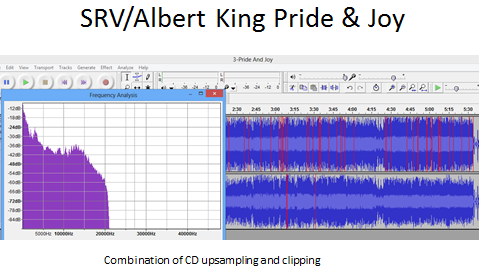
Finally, my real venom is reserved for another HD tracks download – the 24/96 download (from 2010) of Stevie Ray Vaughan and Albert King – “In Session”. I have to admit that I was originally surprised that this was released as a high res download as the original source was video, and the sound of the CD was not great. However, I presumed that HD-Tracks had gotten hold of the original masters and delivered outstanding sound. I wasn’t. In fact it sounded – awful. My analysis of this recording can be viewed below:
You can see that not only is there significant clipping, but there is no information above 20kHz (CD range) – this is a CD upsample; I was conned. About this topic, more later.
Points that need to be made:
1. Music critics, when reviewing a recording, should comment on the quality of the recording, the mix and the mastering. None of the critics had the balls to say that Californication was a great album before they made a mess of the master. Is it uncool to say that an album is too loud?
2. If I want to hear noise – I can stand outside a construction site and listen to a pneumatic drill – music should sound like music, drills should sound like drills. Sleigh Bells – I am sure that you are good musicians – I would like to hear your instruments. Grow up and show some confidence in your music. Loudness, to me, is like coating a meal with too much sauce: the sauce tastes ok – but you will never know what the meal underneath tasted like.
3. Itunes normalises the volume on everything. Folks that listen exclusively to music on itunes cannot be impressed by your loudness – so stop turning up the volume Mr Mastering Engineer.
My Favorite Albums of My Lifetime
•December 20, 2012 • 2 CommentsOk – here goes; having had nothing better to do one morning, I decided to make a list of what I thought were the best rock-pop-blues albums of my lifetime. I am sure I have missed many. I decided to list 10 for each year, but allowed for spillover if there were more than 10 goodies each year. What is really surprising is just how poor the 80s were for albums – despite the CD boom, I have fewer than 50 albums per year from 1980-1989 compared with more than 50 per year from 1968-1979 and from 1990 to today: go figure?
FAVORITE ALBUMS BY YEAR OF MY LIFE
2012
- Blunderbuss – Jack Whyte
- The Russian Wilds – Howlin’ Rain
- Jake Bugg – Jake Bugg
- Sunken Condos – Donald Fagen
- What the world needs… – Sugarman 3
- Blues Funeral – Mark Lanegan Band
- Born to die – Lana Del Rey
- Enjoy it while it lasts – Spector
- What the world needs now – Sugarman 3
- Lonerism – Tame Impala
2011
- The Kind is Dead – Decemberists
- Alexander – Alexander
- Arbouretum – Arbouretum
- Everybody Friends Now – Singing Adams
- Nothing is wrong – Dawes
- Build a rocket boys – Elbow
- Kiss each other – Iron and Wine
- Jonathan Jeremiah A – solitary man
- Velociraptor – Kasabian
- Hardcore will never die but you will – Mogwai
- Peter, Bjorn and John – Gimmie Some
- Dye it blond – Smith Westerns
- El Camino – Black Keys
- Into the murky water – Leisure society
- What do you expect from the Vaccines – The Vaccines
2010
- Queen of Denmark – John Grant
- Avi Buffalo – Avi Buffalo
- Destroyer of the void – Blitzen Trapper
- Small craft on a milk sea – Brian Eno
- Forgiveness Rock Record – Broken Social Scene
- Bliss Release – Cloud Control
- Streets of Out Time – Danny and the Champions of the World
- Bananas Foster – Jigsaw Seen
- For the ghosts within – Robert Wyatt
- True love cast out all evil – Roky Erickson & Okkervil River
- Brothers – Black Keys
- High Violet – The National
- Farewell My Lovely – RG Morrison
- …And then we saw land – Tunng
- Becoming a Jackal – Villagers
- The Fool – Warpaint
- Steeple – Wolf People
- Innerspeaker – Tame Impala
2009
- Only Revolutions – Biffy Clyro
- Field Music – Field Music
- God Help The Girl – Stuart Murdoch
- Spinning Top – Graham Coxon
- Musketeer – Larsen B
- Hold Time – M. Ward
- Besnard Lakes – Besnard Lakes
- Ignore the Ignorant – the Cribs
- Hazards of Love – Decemberists
- Yonder is the clock – Felice Brothers
- Duckworth Lewis Method – Duckworth Lewis Method
2008
- The Seldom Seen Kid – Elbow
- That Lucky old Sun – Brian Wilson
- Only By the Night – Kings of Leon
- Sea Sew – Lisa Hannigan
- The Stand Ins – Okkervil River
- Pugwash – 11 Modern Antiquities
- Return to Forever – Returns
- Med suo if eyrum … – Sigur Ros
- Visiter – the Dodos
- The Age of Understatement – Last Shadow Puppets
2007
- Favorite Worst Nightmare – Artic Monkeys
- Ode To Sunshine – Delta Spirit
- Our Love Admire – Interpol
- Dig Lazerus Dig – Nick Cave
- The Stage Names – Okkervil River
- Under the Backlight – Rilo Kiley
- Cruel Guards – The Panics
- Icky Thump – White Stripes
- Chrome Deams II – neil young
- Spoon – Ga Ga Ga Ga Ga
2006
- Whatever People Say I am – Artic Monkeys
- Everything All the Time – Band of Horses
- The Life Pursuit – Belle and Sebastian
- On an Island – David Gilmour
- Sing a long & Lullabies – Jack Johnson
- Black Holes and Revelations – Muse
- Pure Cane Sugar – Sugarman 3
- Broken Toy Soldiers – Raconteurs
- I am not afraid of you and I will beat your ass – Yo La Tengo
- At War With The Mystics – Flaming Lips
2005
- Down in Albion – Babyshambles
- The Alternative to Love – Brendan Benson
- I’m Wide Awake its Morning – Bright Eyes
- The Back Room – Editors
- Hal – Hal
- The Secret Migration – Mercury Rev
- Mighty Rearranger – Robert Plant and the Strange sensation
- Gimmie Fiction – Spoon
- Magic Numbers – Magic Numbers
- Twin Cinema – New Pornographers
2004
- Smile – Brian Wilson
- Funeral – Arcade Fire
- Faded Seaside Glamour – Delays
- Franz Ferdinand – Franz Ferdinand
- Kasabian – Kasabian
- Hopes and Fears – Keane
- You Are My Quarry – Morrissey
- Abbatoir Blues – Nick Cave
- The Libertines – The Libertines
- Who Killed The Zutons? – The Zutons
2003
- Red Devil Dawn – Crooked Fingers
- Transatlanticism – Death Cab for Cutie
- I am Kloot – I am Kloot
- The Civil War – Matmos
- Absolution – Muse
- Yours, Mine and Ours – Pernice Brothers
- Everything Must Go – Steely Dan
- Rainy Day Music – Jayhawks
- O – Damien Rice
- So Much For the City – The Thrills
2002
- Lapalco – Brendan Benson
- Out of Season – Beth Gibbons and Rusty Man
- The Last Broadcast – Doves
- Turn On the Bright Lights – Interpol
- Clone – Leo Kottke & Mike Gordon
- Blacklisted – Neko Case
- Gotham! – Radio 4
- By the Way – Red Hot Chili Peppers
- Surf – Roddy Frame
- Kill the Moonlight – Spoon
- Life on Other Planets – Supergrass
- Yoshimi Battles the Robots – The Flaming Lips
- Phrenology – The Roots
- Yankee Hotel Foxtrot – Wilco
- Mind if We Make Love to You – Wondermints
2001
- Natural History – I am Kloot
- Asleep at the Back – Elbow
- Ryan Adams – Gold
- Once we were trees – Beachwood Sparks
- The Ghost of Fashion – Clem Snide
- Here Be Monsters – Ed Harcourt
- Wicked Grin – John Hammond Jr
- Loss – Mull Historical Society
- Origin of Symmetry – Muse
- The World Won’t End – Pernice Brothers
- Reveal – REM
- Love is Here – Starsailor
- Rings Around the World- Super Furry Animals
- Ugly People versus Beautiful People – Czars
- Is This It? – the Strokes
- White Blood Cells – The White Stripes
- Pneumonia- Whiskeytown
- Rooty – Basement Jaxx
2000
- Nixon – Lambchop
- Parachutes – Coldplay
- Enjoy the Melodic Sunshine – Cosmic Rough Riders
- Lost Souls – Doves
- Figure 8 – Elliot Smith
- Felt Mountain – Goldfrapp
- Sophtware Slump – Grandaddy
- Rated R – Queens of the Stone Age
- Kid A – Radiohead
- Avalanches – Since I left you
- Smile – The Jayhawks
- The Man Who – Travis
- Thirteen Tales of Urban Bohemia – Dandy Warhols
- 69 Love Songs – Magnetic Fields
1999
- Summerteeth – Wilco
- Soft Bullitin – Flaming Lips
- Showbiz – Muse
- Shack – HMS Fable
- Midnight Vultures – Beck
- Live in Chicago – Luther Allison
- US and US only – Charletans
- Play – Moby
- Performance and Cocktails – Stereophonics
- Fight Club Soundtrack – Dust Brothers
1998
- Bring it On – Gomez
- Deserters Songs – Mercury Rev
- International Velvet – Catatonia
- In an Aeroplane Over the Sea – Neutral Milk Hotel
- The Black Light – Calexico
- Car Wheels on a Gravel Road – Lucinda Williams
- A go go – John Scofield
- The Boy with the Arab Strap – Belle and Sebastian
- Tin Planet – Space
- You’ve Come an Long Way Baby – Fatboy Slim
1997
- Songs from Northern Britain – Teenage Fanclub
- Ok Computer – Radiohead
- Urban Hymns – The Verve
- Word Gets around – Stereophonics
- Buena Vista Social Club – Ry Cooder and Others
- Foo fighters – Color and Shape
- Dig your own hole – Chemical Brothers
- Mag Earwig! – Guided by Voices
- Marching Already – Ocean Colour Scene
- Portishead – Portishead
1996
- Coming up – Suede
- Wilco – Being There
- Beautiful Freak – EELS
- Dreamland – Robert Miles
- Fuzzy Logic – Super Furry Animals
- K – Kula Shaker
- Mosely Shoals – Ocean Colour Scene
- Pinkerton – Weezer
- Everything must go – Manic Street Preachers
- Fountains of Wayne – Fountains of Wayne
- Trailer Park – Beth Orton
1995
- Grand Prix – Teenage Fanclub
- It’s great when you’re straight – Black Grape
- Different Class – Pulp
- Tomorrow The Green Grass – Jayhawks
- Stripped – The Rolling Stones
- What’s the story morning glory – Oasis
- Foo Fighters- Foo Fighters
- Supergrass – I should coco
- Mellencollie and Infinate sadness – Smashing Pumpkins
- Great escape – Blur
1994
- The Bends – Radiohead
- Dog Man Star – Suede
- Definitely Maybe – Oasis
- Dummy – Portishead
- Give out but don’t give up – Primal Scream
- Vauxhall and I – Morrissey
- Bizarre Fruit – M People
- Parklife – Blur
- Tales from the Acoustic Planet – Bela Fleck
- Grace – Jeff Buckley
1993
- Frosting on the Beater – the Posies
- Kamakiriad – Donal Fagen
- Suede – Suede
- Symphony or Damn – Terence Trent D’arby
- Ten Sumners Tales – Sting
- Unplugged in New York – Nirvana
- Whatever – Aimee Mann
- Unplugged – Neil Young
- Republic – New Order
- Spilt Milk – Jellyfish
1992
- 0898 Beautiful South – Beautiful South
- Harvest Moon – Neil Young
- Hollywood Town Hall – Jayhawks
- Hypocrisy is the Greatest Luxury – Disposable Heroes of Hiphoprisy
- Automatic for the people – REM
- Dirty – Sonic Youth
- Generation Terrorists – Manic Street Preacherson
- The Future – Leonard Cohen
- Unplugged – Eric Clapton
- Your Arsenal – Morrissey
- Living in a boom time (live) – Tom Robinson
- Diva – Annie Lennox
1991
- Achtung Baby – U2
- Bandswagonesque – Teenage Fanclub
- Stars – Simply Red
- Ten – Pearl Jam
- Blood sugar sex magik – Red Hot Chili Peppers
- Blue Lines – Massive Attack
- Nevermind – Nirvana
- Girlfriend – Matthew Sweet
- Loveless – My Bloody Valentine
- Out of Time – REM
- If this is rock n roll – Saw Doctors
- Screamadelica – Primal Scream
1990
- Ragged Glory – Neil Young and Crazy Horse
- The Hard Way – Steve Earl and the Dukes
- The Hot Spot (soundtrack) – JL Hooker, Taj Mahal, Miles Davis
- Nouveau Flamenco – Ottmar Liebert
- Pills thrills and bellyaches – Happy Mondays
- Reading, writing and arithmetic – Sundays
- Shake your moneymaker – Black Crowes
- Still got the blues – Gary Moore
- Beautiful South – Choke
- Gold Mother – James
- Submarine Bells – The Chills
- Stuck together with God’s glue – Something Happens
1989
- Freedom – Neil Young
- The Stone Roses – the Stone Roses
- Full moon fever – Tom Petty
- Blaze of Glory – Joe Jackson
- Jeff Beck’s Guitar Shop – Jeff Beck
- 3 feet high and rising – De La Soul
- Welcome to the Beautiful South – Beautiful South
- Oh Mercy – Bob Dylan
- Hats – Blue Nile
- Disintegration – the Cure
- Avalon – Van Morrison
1988
- I’m your man – Leonard Cohen
- Sunshine on Leith – Proclaimers
- The Gift – Joe Louis Walker
- Don’t be afraid of the dark – Robert Cray
- Viva Hate – Morrissey
- Roll with it – Steve Winwood
- It takes a million to hold us back – Public Enemy
- Daydream Nation – Sonic youth
- Ancient Heart – Tanita Tikaram
- Home – Hothouse Flowers
- Tracy Chapman – Tracy Chapman
- Volume 1 – Travelling Wilbury’s
1987
- Joshua Tree – U2
- Nothing like the sun – Sting
- Introducing the hardline – Terence Trent D’arby
- Appetite for Destruction – Guns and Roses
- Document – REM
- Faith – George Michael
- Strangeways Here We Come – the Smiths
- Surfin’ with the Alien – Joe Satriani
- The people who grinned themselves to death – Housemartins
- Under the Influence – Mary Coughlan
- Tunnel of Love – Bruce Springsteen
1986
- Bad Influence – Robert Cray
- Born Sandy Devotional – Triffids
- Graceland – Paul Simon
- Licensed to ill – Beastie Boys
- Kicking against the pricks – Nick Cave and the Bad Seeds
- London 0 Hull 4 – Housemartins
- Live Alive – Stevie Ray Vaughan
- The Queen is Dead – Smiths
- So – Peter Gabriel
1985
- Little Creatures – Talking Heads
- Time – The Replacements
- Psychocandy – Jesus and Mary Chain
- Showdown – Albert Collins, Robert Cray, Johnny Copeland
- Dream of the Blue Turtles – Sting
- This is the Sea – Waterboys
- Don’t Stand Me Down – Dexy’s Midnight Runners
- Rum Sodomy and the Lash – Pogues
- Hounds of Love – Kate Bush
- This nation’s saving grace – The Fall
- Brothers in Arms – Dire Straits
1984
- Purple Rain – Prince
- Diamond Life – Sade
- Meat is Murder – Smiths
- Rattlesnakes – Lloyd Cole
- Stationary Traveller – Camel
- Unforgettable fire – U2
- Various Positions – Leonard Cohen
- Born in the USA – Bruce Springsteen
- Cal – Mark Knopfler
- Couldn’t Stand the Weather – Stevie Ray Vaughan
1983
- High Land, Hard Rain – Aztec Camera
- Crises – Mike Oldfield
- Infidels – Bob Dylan
- Introducing the Style Council – Style Council
- Magical Ring – Clannad
- Murmur – REM
- Texas Flood – Stevie Ray Vaughan
- War – U2
- The Luxury Gap – Heaven 17
- Let’s Dance – David Bowie
- The Crossing – Big Country
1982
- The Nightfly – Donald Fagen
- Avalon – Roxy Music
- Lexicon of Love – ABC
- Too Ray Ah – Dexy’s Midnight Runners
- Upstairs at Erics – Yazoo
- Love over Gold – Dire Straits
- Night and Day – Joe Jackson
- One from the heart – Tom Waits and Crystal Gayle
- Shoot out the lights – Richard and Linda Thompson
- Concert in Central Park – Simon and Garfunkle
1981
- Dare – the Human League
- Time – ELO
- Ghosts in the Machine – The Police
- Give the people what they want – the Kinks
- Glorious Fool – John Martyn
- Jumpin’ Jive – Joe Jackson
- No sleep till Hammersmith – Motorhead
- Shut up and play yer guitar – Frank Zappa
- Tatoo You – Rolling Stones
- Freeze Frame – J. Giles Band
- Hi Infidelity – REO Speedwagon
1980
- Back in Black – AC/DC
- Sound Effects – The Jam
- Signing Off – UB40
- The River – Bruce Springsteen
- Boy – U2
- Closer – Joy Division
- Grace and Danger – John Martyn
- Making Movies – Dire Straits
- Gaucho – Steely Dan
- Searching for the New Soul Rebels – Dexys Midnight Runners
- Scary Monsters – David Bowie
- Kings of the wild frontier – Adam and the ants
1979
- The Wall – Pink Floyd
- Communique – Dire Straits
- Do it yourself – Ian Dury
- Damn the Torpedos – Tom Petty
- Discovery – ELO
- London Calling – The Clash
- Rust Never Sleeps – Neil Young
- Replicas – Tubeway Army
- Off the Wall – Michael Jackson
- Singles Going Steady – Buzzcocks
- Setting Sons – The Jam
- Specials – The Specials
- Great rock n roll swindle – Sex Pistols
- Armed Forces – Elvis Costello
- Repeat when necessary – Dave Edmunds
1978
- Equinoxe – Jean Michel Jarre
- Jazz – Queen
- Live and Dangerous – Thin Lizzy
- Tonic for the troops – Boomtown Rats
- Saturday Night Fever (soundtrack) – Bee Gees etc.
- Outlandos D’Amour – Police
- Parallel Lines – Blondie
- Some Girls – Rolling Stones
- Van Halen – Van Halen
- This year’s model – Elvis Costello
- All mod cons – The Jam
- If you want blood – ACDC
- Ambient 1: Music for airports – Brian Eno
1977
- Aja – Steely Dan
- The Clash – the Clash
- Bat out of hell – Meat Loaf
- Animals – Pink Floyd
- Lust for Life – Iggy Pop
- New Boots and Panties – Ian Dury
- Exodus – Bob Marley
- Never Mind the Bollocks – Sex Pistols
- Hard Again – Muddy Waters
- Out of the Blue – ELO
- The Stranger – Billy Joel
- My Aim is True – Elvis Costello
- Rumours – Fleetwood Mac
1976
- Boston – Boston
- A New World Record – ELO
- Albert – Albert King
- Desire – Bob Dylan
- Fly Like an Eagle – Steve Miller Band
- Frampton Comes Alive – Peter Frampton
- Hotel California – Eagles
- Jailbreak – Thin Lizzy
- Made in Europe – Deep Purple
- Book of Invasions – Horslips
1975
- Blood on the Tracks – Bob Dylan
- Born to Run – Bruce Springsteen
- British tour ’75 – Soft Machine
- Blow by Blow – Jeff Beck
- Chocolate City & Mothership Connection – Parliament
- Horses – Patti Smith
- Physical Graffiti – Led Zeppelin
- Still Crazy after all These Years – Paul Simon
- Rotter’s Club – Hatfield and The North
- Big Star – Third/Sister Lover
- Tonight’s the Night – Neil Young
- Wish you were here – Pink Floyd
1974
- Pretzel Logic – Steely Dan
- 461 Ocean Boulevard – Eric Clapton
- Isotope – An Isotope
- Feats don’t fail me now – Little Feat
- Inspiration Information – Shuggie Otis
- Irish Tour ’74 – Rory Gallagher
- It’s too late to stop now – Van Morrisson
- On the Beach – Neil Young
- The Heart of Saturday Night – Tom Waits
- Radio City – Big Star
- Before the Flood – Bob Dylan and the Band
- Grievous Angel – Gram Parsons
1973
- Berlin – Lou Reid
- Catch a fire – Bob Marley
- Dark side of the Moon – Pink Floyd
- Desperado – Eagles
- Larks tongue on Aspic – King Crimson
- Lotus – Santana
- New York Dolls – New York Dolls
- Raw Power – The Stooges
- Straight Ahead – Brian Auger’s Oblivion Express
- Lynyrd Skynyrd – Pronounced….
- Alladin Sane – David Bowie
1972
- Harvest – Neil Young
- Machine Head & Made in Japan – Deep Purple
- Exile on Main St. – Rolling Stones
- Matching Mole – Little Red Book
- Manassas – Stephen Stills
- Pink Moon – Nick Drake
- Paul Simon – Paul Simon
- Can’t Buy a Thrill – Steely Dan
- Discover America – Van Dyke Parks
- Waka Jawaka – Frank Zappa
- Ziggy Stardust – David Bowie
- #1 record – Big Star
- Transformer – Lou Reid
1971
- At the Filmore East – Allman Brothers
- Led Zeppelin IV – Led Zeppelin
- Meddle – Pink Floyd
- Sticky Fingers – Rolling Stonesye
- Who’s next – The Who
- Stormcock – Roy Harper
- Teenage Head – Flamin Groovies
- Tapestry – Carole King
- Whats Goin’ On – Marvin Ga
- Blue – Joni Mitchell
- Gonna Take a Miracle – Laura Nyro
- Hunky Dory – David Bowie
- If I could only remember my name – David Crosby
- In the land of grey and pink – Caravan
- Relics – Pink Floyd
- Aqualung – Jethro Tull
1970
- John Barleycorn Must Die – Traffic
- Layla and Other assorted songs – Derek and the Dominos
- Led Zeppelin III – Led Zeppelin
- Live at Leeds – The Who
- Lola versus Powerman… – The Kinks
- Moondance – Van Morrison
- Stephen Stills – Stephen Stills
- Soft Machine – Third
- Paranoid – Black Sabbath
- Fire and Water – Free
- After the Goldrush – Neil Young
- Workingman’s dead – Grateful Dead
- Bridge over troubled waters – Simon & Garfunkle
- Byther Lyther – Nick Drake
- Nucleus – Elastic Rock
- Fun House – The Stooges
- Gentle giant – Gentle Giant
- End of an Ear –Robert Wyatt
- Hold That Plane – Buddy Guy
- In Rock – Deep Purple
- Band of gypsies – Jimi Hendrix
- No Dice – Badfinger
- Eric Clapton – Eric Clapton
1969
- Hot Rats – Frank Zappa
- Abbey Road – The Beatles
- Crosby Stills and Nash – Crosby Stills and Nash
- Elvis in Person at the International Hotel Vegas – Elvis Presley
- Led Zeppelin 1 – Led Zeppelin
- Let It Bleed – Rolling Stones
- Songs from a Room – Leonard Cohen
- The Band – The Band
- Tommy – The Who
- Valentyne Suite – Collosseum
- In the Court of King Crimson – King Crimson
- Child Is Father to the Man – Blood, Sweat and Tears
- Dusty in Memphis – Dusty Springfield
1968
- A Man and the Blues – Buddy Guy
- Astral Weeks – Van Morrisson
- Beggars Banquet- Rolling Stones
- Cheap Thrills – Big Brother and the Holding Company
- Lumpy Gravy – Frank Zappa
- Peter Green’s Fleetwood Mac – Fleetwood Mac
- Shades of Deep Purple – Deep Purple
- The Beatles (white album) – The Beatles
- Notorious Byrd Brothers – Byrds
- Village Green Preservation Society – Kinks
- Electric Ladyland – Jimi Hendrix
1967
- Something Else – The Kinks
- The Doors – the Doors
- Velvet Underground and Nico – Velvet Underground and Nico
- Are You Experienced? – Jimi Hendrix
- Born Under a Bad Sign – Albert King
- Goodbye and Hello – Tim Buckley
- Magical Mystery Tour – Beatles
- Sgt Pepper – Beatles
- Piper at the Gates of Dawn – Pink Floyd
- Between the Buttons – Rolling Stones
- Absolutely Free – Frank Zappa
- Thirteenth Floor Elevators – Thirteenth Floor Elevators
- Smiley Smile/Wild Honey – Beach Boys
- Forever Changes – Love
What I hate about Hi-Fi
•December 18, 2012 • Leave a Comment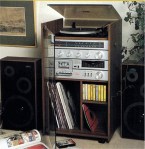 Back in the 1970s and 80s, our parents generation were split in 3 in audio terms. Some families idea of hi-fi was a radio, or a cassette player, a Dansette record player or nothing at all. Up a level was the music centre family: this was a big silver box, made by JVC/Sony/Hitachi that contained a record player, cassette deck and radio tuner: in 1 box with matching speakers: I obtained my own one of these, a Toshiba music center in 1982. Then there was “Hi-FI”: this was a “rack” system of individual components – turntable, cassette deck, tuner, perhaps reel-to-reel, pre-amp, power-amp and speakers – all usually made by different manufacturers. The coolest dads had these and we were not allowed to touch them. Usually the makers of these components were the same Japanese manufacturers of music centers, sometimes they were elegant music centres (by Bang and Olfsen for example), but the best and coolest hi-fi was made by brands that your average teenager had never heard of: Linn, Wharfdale, Arcam, Meridian, Quad, Pink Triangle etc. I accidentally fell into Hi-Fi in the mid 1990s, when I went to buy a turntable to play on a mini system, and discovered a 70s era Sansui amplifier in the shop (it had been
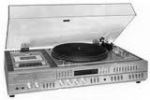 traded it). I brought it home, plugged to old turntable into the amp, and bang – I was blown away and the mini system went into permanent storage. This was joined by a Marantz CD52 MkII, a Marantz tuner, a Pioneer A400 amplifier (that was highly rated but didn’t sound half as good as the Sansui – it was subsequently traded for an Arcam alpha-one), Wharfdale speakers and stands, thick cords etc. Budget hi-fi nirvana. Then I got married and discovered that my hi-fi took up half the kitchen and went into storage. Subsequently, I have flirted with lots of different hi-fi devices, have some nice kit – such as a Clear-Audio turntable, and Croft pre- and power amps, and guess what – they are now in storage. I love hi-fi and hate it at the same time. So here is what I hate about hi-fi:
1. The boxes – they are big and ugly and take up too much space. Great to impress your friends in bachelor pads, but not for families. I have a 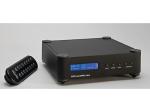 Wadia power DAC mini – it is the size of about 10 mouse mats stacked up on top of one another. This device is a DAC/preamp/digital poweramp and it powers a couple of dinky Monitor audio speakers and subwoofer in my office: the sound is bloody good.
2. The lack of storage furniture: hi-fi storage is all about a series of shelves, that take up half the living room, and are way to accessible to small hands.
3. Hi-Fi snobbery: it is pathetic. I buy audio devices to listen to music. It is great if the music sounds really good; but that is a bonus. Hi-Fi enthusiasts (not all of them) seem to spend more time analysing just how good the sound is, tweaking their systems with all kinds of accessories, constantly upgrading to improve sound – that they never seem to spend much time listening to music.
4. The term “lifestyle audio” – what a load of bollocks: if hi fi enthusiasts think that your nice looking small proportioned music device is not up to their “golden ears” they term it a “lifestyle” device. Bose speakers have been consigned to that role for decades: most owners think that their Bose gear (which is overpriced) sounds great and, due to their promotional activity, it impresses their friends. More importantly, it doesn’t take up half of their living rooms.
5. The “Dealer” network. So, if I want to buy a particular device – say for example the Naim Supernait – can I go to a website and order it. No. Tough shit – if you want to buy the device you have to hoof it to the nearest dealer to audition it in their listening room before buying it. That would be great if there was a dealer within a couple of hours drive of your home – but there is non even in the country (I live in the West of Ireland, a hi-fi wasteland). Yes I know, if you are lucky enough to have a dealer nearby, they become life long friends, help you to system match, take trade ins of crappy components that they will have trouble offloading, and they are very knowledgeable. The problem is that there are very few of them and their numbers are declining. Take, for example, my hometown, Dublin. In the 1990s there were loads of places to buy Hi-Fi (mostly budget stuff, but Hi-Fi nonetheless). Now there is 1 – Cloney: and they carry very little stock. Now – I love Cloney, and they are very helpful – but it is not exactly an impulse buying shop is it? European hi-fi retail needs to move into the 21st century and sell mid-end products on line to people with itchy mouse fingers like me. What really irks me is that I still get newsletters from US based music direct – and they sell lots of really cool stuff to Americans over the internet (at good prices too).
6. The “Cable” rip-off. There is no question that for analogue audio, that high quality interconnects and speaker cable make a huge difference to the sound of your hi-fi system. The big question is – how much should you pay for this benefit, and does it translate to other cables? A few years ago I aquired a Croft pre and power amp and B&W floorstander speakers. I had no decent speaker cables, so I went to Maplin and bought whatever was their thickest priciest cable (it probably cost me 20 or 30 euro). The system sounded great – open sound, lots of clear treble, deep base, great soundstage. However, based on years of reading Hi-fi magazines, and living in hi-fi wasteland, I ordered expensive (300 euro) cable on the internet. Attached to my system – it sounded – worse. I decided that it must be my ears. It wasn’t. After a year or so, I rolled up the cable and went back to the original Maplin stuff. Do I think that I would get better sound out of $500 Nordost speaker cable? I don’t know, but how could I be sure unless some nice dealer shipped me a variety of cables to try out in my system in my home.
So, I do believe in good quality analogue cables – they make sense, there is some reasonable science, but I am not sure where the inflection point between price and sound improvement is. On the other hand, the whole AV cable think really get up my goat. You go into Currys or Best Buys and attempt to buy a $100/£75/E100 Blu-ray player. Good value you think. Then the salesman informs you that there is no HDMI cable in the box and ushers you to a wall of various branded wires: 39.99 for 1m; 59.99 for 2m. <Where are the cheap cables?> “This is all we carry” – in other words – your Blu-ray player won’t work on your TV unless you spend almost as much again on a super-duper HDMI cable to connect it – and you are stuck buying that cable because we make lots of profit selling them. Fuck you! I have been reading for years about how one HDMI cable is the same as the next. Digital is digital – optical, coaxial, DVI, HDMI – once the data is transmitted it is reconstructed in the TV irrespective of the mode of transport. Thankfully, Currys are now selling cheap cables – known as Currys essential.
7. Budget versus High End – you spend $1000 on a CD player and some knob informs you that this is a fine “budget” component. You should be given full permission to kick his head with no consequences. Yes the more you pay for hi-fi the greater the likelihood that it will sound better. So, if you spend $500 on a component it will sound twice as good as a $250 component; if you spend $1000 on a component – 25% improvement over $500; $2000 – probably a 10%. Above that, who the hell knows. The bottom line is, that once you get over the $1000/£1000 mark the marginal improvement in sound quality is just that – marginal. Often you are not paying for higher quality components, but for low volume sales, better soldering and advertising costs. If you are going to spend a lot of money on components – it should be on those items that will age little with technologic developments – in other words analogue: preamps, poweramps, turntables and speakers. Spending $5000 on an SACD player makes no sense whatsoever – nor does buying an expensive media server, CD player or Blu-ray player. You are much better off spending $200o on a highish end DAC and plugging budget components into it. And forget about copy protected SACDs. Put them all in the attic and buy the PCM files on HDTracks: at least then you will own the music.
8. Hi-Fi Magazines: these journals exist only to induce desire in reader. s so that they will go out an squander large amounts of money on new kit that is not necessarily better than their old kit. For example, last year I bought an Oppo BD95: based on magazine reviews I believed that I was getting an absolutely top notch universal player for a budget price. I plugged it in, attached an expensive set of analogue audio cords, and then started playing a series of CDs/SACDs/BDs/DVAs. They all sounded really good. I then put a flac encoded DVD into the drive – sounded good: then I flicked the input on the pre-amp to my Benchmark DAC-1 USB, attached to the BD95 via a cheap optical cable. I was devastated – it was like a veil had been lifted and an astonishingly new level of clarity, soundstaging and space revealed itself. I may as well have kept my old Oppo DVD player – those highly trumped twin 32 bit Sabre DACs in the BD95 were absolutely no match for the Benchmark. In this months hi-fi magazines there is coverage of the new BD103 that features – digital, in to make use of the DAC (wonderfully useful), no fan and improved sound quality. Immediate reaction – I want I want. But I know that it still won’t be as good as my Benchmark DAC. The only cure for the desire-itis is to stop buying Hi-Fi mags.
Another example of the questionability of these publications is the Arcam FMJ series. I have an old Arcam alpha-1 amplifier that I rather like, and considered buying a newer amp by the same company – the FMJ series. Luckily a friend of mine had said amp and was willing to lend it to me for a trial. I plugged it in, listened, was unbelievably underwhelmed, plugged in the old alpha-1 – hugely better. I invited my friend over: same reaction – the 15 year old amplifier kicked the crap out of the new model by the same company. An it was recommended by the hi-fi mags. A similar story happened to me when I bought the highly recommended Pioneer A400 in the mid 90s: no bass, none, absent, totally crap. So, my message is – if you have old audio equipment and you like the sound – hang onto it, the new gear is unlikely to sound better.
9. Home Cinema: I was the first person I know to wire up my living room for 5.1 and the first I know to abandon it. Home cinema sound is great if 1. You have a large soundproofed room dedicated to nothing but watching TV; 2. You are willing to buy an AV amp the size of a carry on suitcase, that generates as much heat as a volcano; 3. You buy hi-fi speakers. All other home cinema stuff is totally crap and should be avoided. I know that LED TVs are very thin and you can hang them on the wall like pictures: unfortunately they sound shite. Your best bet is to buy a soundbar from the same manufacturer as the TV. It will sound just fine. Don’t waste your time on one of those, dare I say it – lifestyle – 5.1 Blu-ray systems for $£E300-400: they might look good, but the sound is dire. During quiet phases you have to pump up the volume to hear the dialogue, then suddenly you are blasted by 150DB of noise/loud music that drowns out all else. Good home cinema requires that you can easily balance the sound from each speaker, and adjust volume accordingly. You would be better off plugging your TV into a cheap stereo amp and buying a couple of small speakers/subwoofer. Home cinema is not hi-fi and it should not be sold in hi-fi shops. I would, nevertheless like a proper audiophile multi-channel hi-fi amplifier so that I can listen to my quadrophonic sound SACDs and DVDa discs.
Squeezed out of the Market
•December 18, 2012 • Leave a CommentFor several years I have used the Sonos multi-room audio system. I can’t claim that this is hi-fi, as it is not, but it allows me to access all of my CD collection, Spotify and radio all over the house. Unfortunately the base “connection” unit, the zoneplayer 90, retails for euro 350, and the first one that I ordered died and had to be replaced. Moreover, it has a very weak DAC, so I have outputted it to my Benchmark DAC-1 USB for a couple of years, and the quality of sound, user interface and listening experience is stunning. I am very loyal to Sonos and have added a couple of Play 3s and Play 5s over the years, a couple of controllers etc. But there is a big problem with the system – no support for 24 bit files. So what do you do? There are lots of 24/96 or 192 media players available from big Hi-Fi firms – the best of which is Sooloss from Meridian, which costs thousands. Naim have a nice system, as do Linn, Musical Fidelity and various other hi-fi manufacturers.
If I was to buy a media-streamer this is what I would want:
1. Support for 24/192 with a high end DAC
2. Several optical, coaxial and USB inputs to utilize the DAC
3. A 4 or 5 inch touchscreen interface that displays album art
4. Internet radio and support for Spotify, Deezer and Rhapsody.
5. Standalone play that will play files directly from USB discs and can also access a media server.
6. Moderate price (<euro 1000) and scalability.
7. A headphone output.
8. Small and Family Friendly
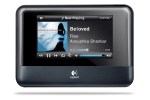 I looked at the Logitech Transporter originally, years ago, but it was just too expensive not to be produced by Linn or Meridian (and thus having little or no trade in value). I looked at Linn, Naim – too expensive and then I realized that I did not need items 1 and 2 above. I already had a high end DAC. What I needed was a device that would play 24 bit files with a nice user interface, that could be outputted to my DAC. I experimented with a 250 euro netbook running j river media center – but it was all a bit – ugly. Then I came across the squeezebox touch, in my local Curry’s, for euro 250! I looked at the box for about 20 minutes – 24 bit file support (all files, flac, mp3, AAC, Ogg etc) check, touchscreen – check, optical and coaxial output – check, usb connectivity – check, album art – check. <Must be a pricing error – this should cost 1,250 euro- it must be a mistake. But no – this is – was – the best value Hi-Fi product ever. Period. It worked straight out of the box. Ok, I must confess that I did not use the squeezeserver software because 1. I was using it in a location that already had a Sonos box (that doesn’t need to be continuously connected to a PC/Mac and is just better at it), 2. I only needed one box to play 24 bit music in one locations. So I put my 24 bit files on one of those impossibly small usb mini thumb drives – and ran the internal server, connected the coaxial cable to the Benchmark and sat back and enjoyed the music. It was spectacular. An the cute little device was family friendly – the kids had no problem playing or accessing tracks. Ok, it could be tricked out in expensive aluminium or wood and sold as an expensive product, and it looks a little cheap: but it was 250 euro! I bought my dad a squeezebox radio – he loves it. I felt that the Squeezebox people were only a couple of small steps away from total market domination: all they needed to do was to bring out a larger product range, hire an aesthetic designer – so that their products appeal to the iPod-phone-pad generation, improve the squeeze-server technology, and take the Logitech computer brand off the product and call it something else (hell just buy an old hi-fi company and use their branding). So what happened….?
Logitech have, inexplicably, pulled the plug. Squeezebox has been dropped as a line of products: no explanation. Over. Presumably they have not been making money with the Squeezebox products, and Logitech are refocusing on core businesses – Keyboards and Mice (so 20th century) and multi-function remote controls. They are also pushing a Skype camera for your TV. It has to be said, this is not a company that has a clear vision for the future. It seems that Logitech have been in financial trouble for several years: apparently they wasted a lot of effort on the google tv and were broadsided by the iPad. Nevertheless, in the Squeezebox, Logitech owned a market niche – literally nobody was producing a comparable product that was future proofed and well received by consumers. It would have been relatively easy to integrate the squeeze products into a range that catered for tablets, smartphones, DSs, Playstations etc. (think Netflix).
Any sensible person would nip down to their nearest Currys/Best Buy and pick up one of the last remaining Sqeezeboxes. With Logitech out of the market, I don’t see anyone else coming in in a hurry. The only company with imagination, guile, style and interest in moderate price points is Bowers and Wilkins. How about a Music User Interface guys?
 audioexchange